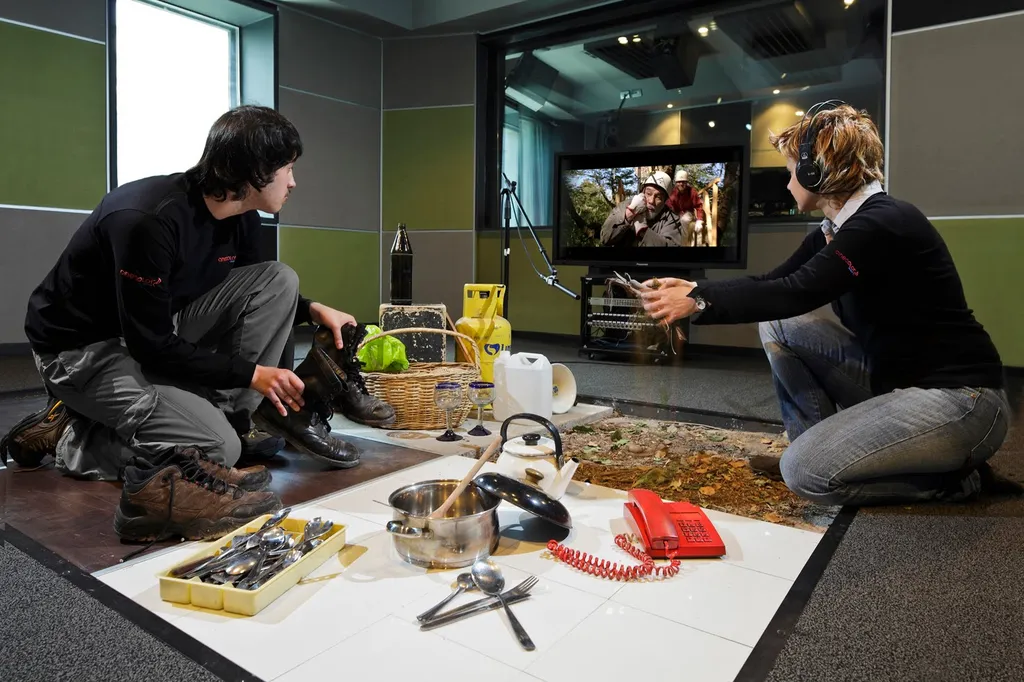
In a groundbreaking development for multimedia production, researchers have introduced Video-Foley, a novel system that automates the creation of foley sounds—those everyday noises added to films, TV shows, and other media to enhance the audio-visual experience. This innovation addresses a longstanding challenge in the industry: the labor-intensive process of manually synchronizing sound effects with on-screen actions.
Video-Foley leverages a two-stage approach to generate sound from video, bypassing the need for costly and subjective human annotation. The system first converts video frames into a temporal event feature called Root Mean Square (RMS), which acts as a frame-level intensity envelope closely related to audio semantics. This RMS feature serves as an intuitive condition to guide the subsequent audio generation process. The second stage, RMS2Sound, incorporates novel ideas such as RMS discretization and RMS-ControlNet, which work in tandem with a pretrained text-to-audio model to produce the final sound effects.
The researchers’ extensive evaluations demonstrate that Video-Foley achieves state-of-the-art performance in audio-visual alignment and controllability. This means that the system can precisely match the timing, intensity, and nuance of sounds to the corresponding visual events, a critical aspect of foley sound synthesis. Moreover, the system’s ability to use semantic timbre prompts—either audio or text—offers a high degree of flexibility and control over the generated sounds.
For music and audio production, the practical applications of Video-Foley are substantial. Producers and sound designers can streamline their workflows by automating the creation of sound effects that are temporally and semantically aligned with visual content. This can significantly reduce the time and effort required for post-production, allowing for more efficient and creative processes. Additionally, the system’s ability to generate sounds from text prompts opens up new possibilities for accessibility and inclusivity in multimedia production, enabling users to create or modify sound effects without extensive technical knowledge.
The researchers have made their source code, model weights, and demos available on a companion website, inviting the broader community to explore and build upon this innovative technology. As the field of multimedia production continues to evolve, Video-Foley stands as a testament to the power of advanced algorithms and machine learning in transforming traditional workflows and unlocking new creative potential. Read the original research paper here.