
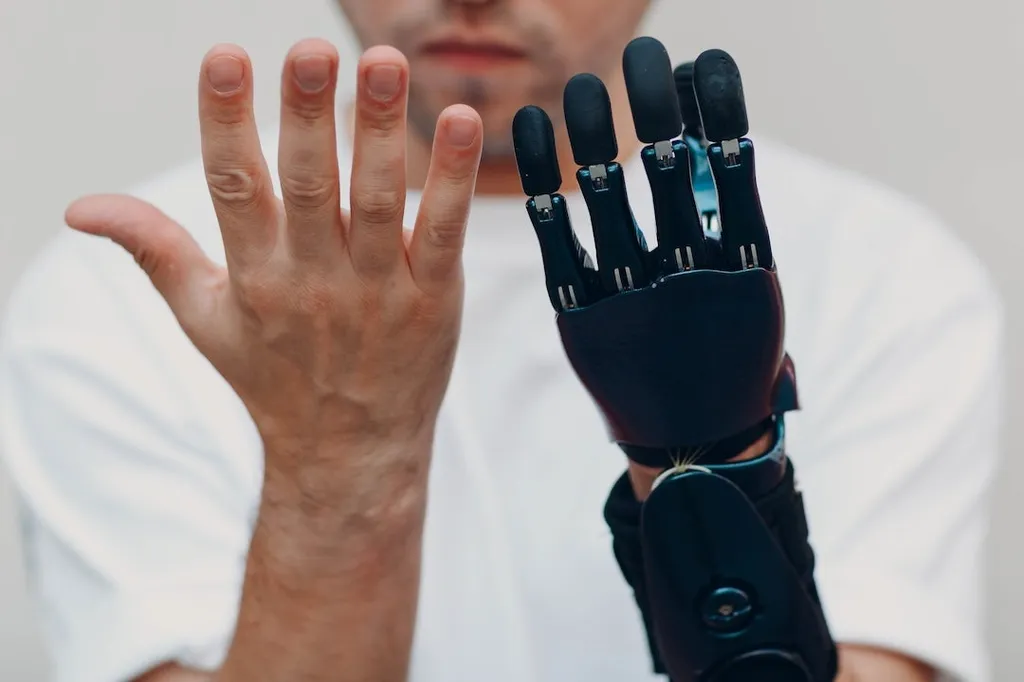
In the realm of robotics, virtual reality, and biomechanics, understanding the intricate dance of hand movements and interactions is crucial. Yet, this task has been a formidable challenge due to visual obstructions, subtle contact cues, and the limitations of current sensing technologies. Enter VibeMesh, a groundbreaking wearable system developed by a team of researchers including Yuemin Mao, Uksang Yoo, Yunchao Yao, Shahram Najam Syed, Luca Bondi, Jonathan Francis, Jean Oh, and Jeffrey Ichnowski. This innovative system combines vision with active acoustic sensing to provide a detailed, real-time map of hand pose and contact events.
VibeMesh is a lightweight, non-intrusive platform that integrates a bone-conduction speaker and sparse piezoelectric microphones distributed across the hand. The system emits structured acoustic signals and captures their propagation, using changes in these signals to infer contact points and hand movements. To make sense of this complex data, the researchers developed a graph-based attention network that processes synchronized audio spectra and RGB-D-derived hand meshes. This cross-modal approach allows VibeMesh to predict contact with remarkable spatial resolution.
The practical applications of VibeMesh are vast and exciting, particularly in the world of music and audio production. Imagine a virtual reality environment where musicians can interact with instruments in a completely immersive way, with every nuance of hand movement and contact accurately captured and translated into sound. VibeMesh could also revolutionize the way we create and manipulate digital audio, providing a more intuitive and precise interface for sound design and editing.
The researchers have also contributed a dataset of synchronized RGB-D, acoustic, and ground-truth contact annotations across diverse manipulation scenarios. This valuable resource will enable further advancements in the field, as other researchers and developers build upon this work. Empirical results have shown that VibeMesh outperforms vision-only baselines in accuracy and robustness, particularly in challenging scenarios involving occlusion or static contact.
In essence, VibeMesh represents a significant leap forward in our ability to understand and interpret hand movements and interactions. Its potential to enhance immersive experiences, improve robot data-collection, and advance biomechanical analysis is immense. For the music and audio production industries, VibeMesh could open up new avenues for creativity and innovation, pushing the boundaries of what’s possible in the digital realm. As this technology continues to evolve, we can expect to see even more exciting applications and developments on the horizon.