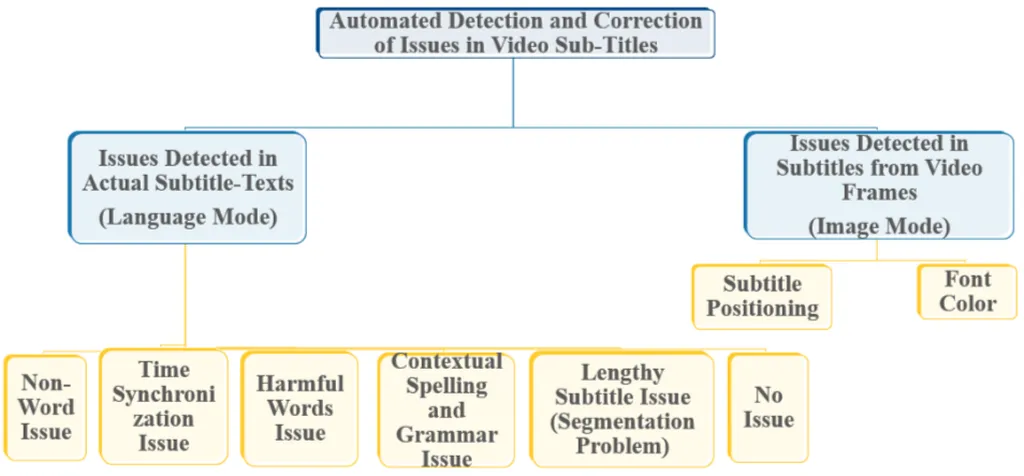
In the era of digital content proliferation, the demand for accurate and accessible subtitles has never been higher. Streaming platforms and social media are flooded with audiovisual content, making subtitles an essential tool for accessibility and comprehension. However, current subtitle generation methods, whether based on speech transcription or optical character recognition (OCR), often fall short. Issues such as poor synchronization, incorrect or harmful text, inconsistent formatting, inappropriate reading speeds, and the inability to adapt to dynamic audio-visual contexts are common. These shortcomings leave post-editing as a labor-intensive and time-consuming process.
Enter V-SAT, the Video Subtitle Annotation Tool, a groundbreaking framework designed to address these challenges comprehensively. Developed by a team of researchers including Arpita Kundu, Joyita Chakraborty, Anindita Desarkar, Aritra Sen, Srushti Anil Patil, and Vishwanathan Raman, V-SAT leverages a combination of Large Language Models (LLMs), Vision-Language Models (VLMs), Image Processing, and Automatic Speech Recognition (ASR). This unified approach allows V-SAT to detect and correct a wide range of subtitle quality issues by utilizing contextual cues from both audio and video.
The impact of V-SAT on subtitle quality is substantial. The SUBER score, a metric for evaluating subtitle quality, was reduced from 9.6 to 3.54 after resolving all language mode issues. Additionally, V-SAT achieved F1-scores of approximately 0.80 for image mode issues, indicating high accuracy in detecting and correcting visual context-related errors. The integration of human-in-the-loop validation further ensures the high quality of the subtitles produced, providing a robust solution for subtitle annotation.
The practical applications of V-SAT in the music and audio production industry are vast. Accurate subtitles are crucial for music videos, live performances, and audio-visual content on streaming platforms. They enhance accessibility for the hearing impaired, improve comprehension for non-native speakers, and ensure that the artistic intent is preserved. Moreover, the ability to automatically detect and correct subtitle errors can significantly reduce the time and effort required for post-editing, allowing producers and editors to focus on other aspects of content creation.
V-SAT represents a significant step forward in the field of subtitle generation. By addressing the shortcomings of current methods and providing a comprehensive solution, it sets a new standard for subtitle quality. As the demand for accessible and accurate subtitles continues to grow, tools like V-SAT will play an increasingly important role in the production and dissemination of audiovisual content. The integration of advanced technologies such as LLMs, VLMs, and ASR ensures that V-SAT is well-equipped to meet the evolving needs of the industry, making it an invaluable asset for content creators and consumers alike.