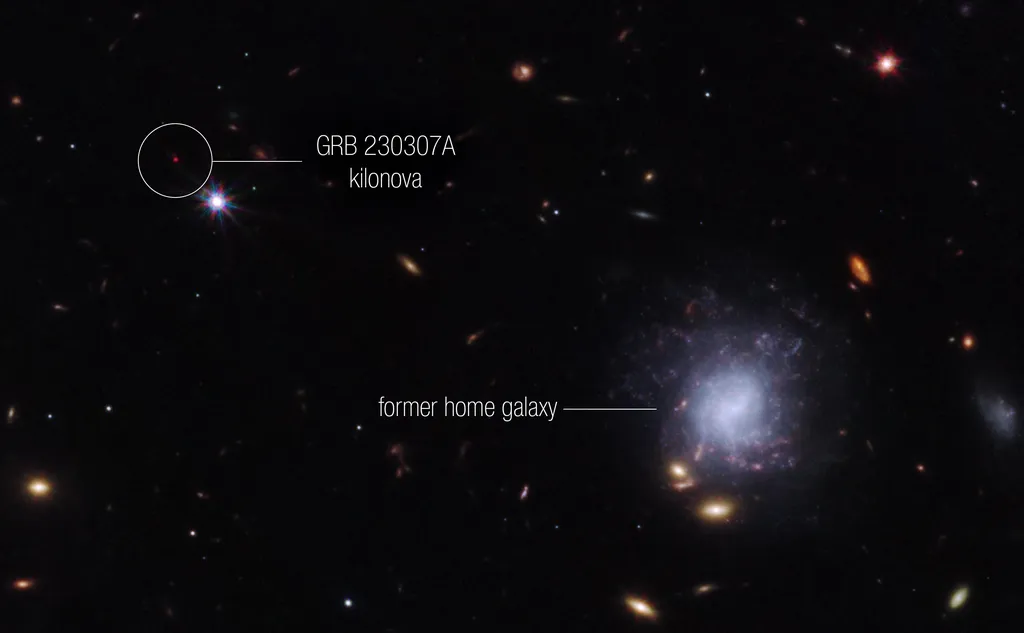
In a groundbreaking study, researchers Agnieszka Janiuk, Joseph Saji, and Gerardo Urrutia have delved into the intricate mechanisms behind the gamma-ray bursts (GRBs) associated with kilonova emissions. Their research focuses on the radioactive decay of elements synthesized in accretion disk winds, shedding light on the chemical evolution and implications of post-merger accretion disk winds. This study is pivotal in understanding the cosmic phenomena that follow the merger of compact binary systems, such as neutron stars or black holes.
The team employed sophisticated computational models to simulate the r-process nucleosynthesis in accretion disk winds, a process that occurs during the prompt GRB phase. They conducted time-dependent General Relativistic Magnetohydrodynamic (GR MHD) simulations of a GRB central engine, where a newly formed black hole accretes mass from the post-merger remnant. By exploring a range of initial parameters, the researchers studied representative cases for various compact binary merger progenitors. Their simulations were conducted in both 2D and 3D, utilizing a tabulated three-parameter equation of state that allows for the evolution of the chemical composition of the accretion flow.
One of the key aspects of their research involved accounting for neutrino emission through a leakage scheme, where the neutrino optical depth was calculated along radial rays. The team parameterized optically thick and thin tori with different values of pressure maximum and entropy in the disk, while the strength of large-scale poloidal magnetic fields was parameterized according to the chosen gas-to-magnetic pressure ratio. To probe the winds, they followed particle trajectories, deriving the nucleosynthetic yields of heavy elements in the outflows and mapping the regions of Lanthanide-rich and poor ejecta.
The findings reveal that the outflow carries a high mass of neutron-rich material expanding with mildly relativistic velocities. The accretion disks operating under the Standard and Angular Momentum (SANE) mode can power the GRB jets via neutrino annihilation if the disk-to-black hole mass ratio is larger than about 0.01 and the black hole is spinning. Interestingly, slowly spinning black holes surrounded by massive post-merger disks can also power these jets and be sites of efficient nucleosynthesis of Lanthanides.
This research not only advances our understanding of the physical processes involved in GRBs and kilonovae but also has significant implications for the study of heavy element nucleosynthesis in the universe. The detailed simulations and parameter studies provide a comprehensive framework for interpreting observational data and guiding future research in astrophysics and nuclear physics. As we continue to unravel the mysteries of the cosmos, such studies bring us closer to deciphering the fundamental processes that shape our universe.