
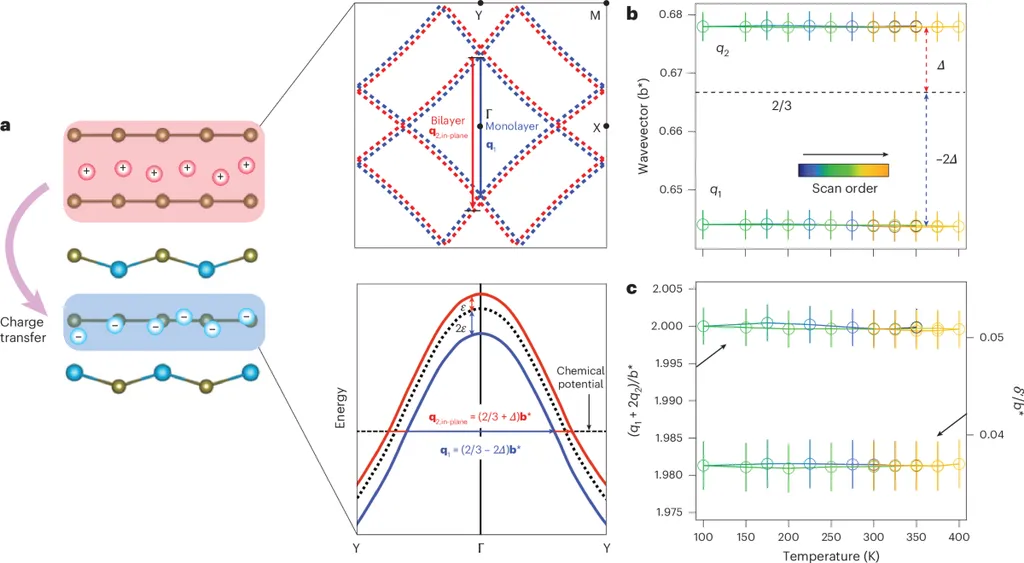
In the world of condensed matter physics, the study of charge density waves (CDWs) has always been a fascinating endeavor. These waves represent a periodic modulation of charge that can break the translational symmetry of a material, leading to a plethora of intriguing phenomena. Recently, a team of researchers—Paula Mellado, Francisco Muñoz, and Javiera Cabezas-Escares—has delved into the intricacies of incommensurate charge density waves, specifically within layered materials. Their findings, published in a recent study, offer a fresh perspective on how these waves form and behave.
The researchers focused on a half-filled, four-band tight-binding model on a ladder structure. This model is unique because it includes a relative shift, denoted as δ = p/q, between the legs of the ladder. This shift is induced by the dimerization of one of the legs, creating a moiré supercell that comprises q composite cells. The result is a modulated inter-leg tunneling effect, which compresses the leg bands into flat minibands near the Fermi level. This compression leads to additional low-energy peaks in the density of states, a crucial factor in understanding the electronic properties of the material.
Including Coulomb interactions in their model, the researchers discovered an incommensurate charge-density-wave phase. In this phase, the charge modulation is out of phase between the legs of the ladder. This finding is significant because it highlights the role of interlayer incongruities in the formation of excitonic charge-ordered phases. The collective excitations of this state are long-lived neutral, acoustic phasons. These phasons are gapless phase fluctuations, and their speed is controlled by the moiré parameter δ and the inter-leg tunneling amplitude.
The implications of this research are far-reaching. By shedding light on the role of interlayer incongruities, the study provides a deeper understanding of the mechanisms behind the onset of incommensurate charge order in layered materials. This knowledge is particularly relevant for van der Waals materials and heterostructured materials, where the interplay between layers can lead to novel electronic properties.
Moreover, the discovery of long-lived acoustic phasons adds another layer of complexity to our understanding of charge density waves. These excitations could play a crucial role in the development of new materials with tailored electronic properties. As researchers continue to explore the intricacies of incommensurate charge density waves, the insights gained from this study will undoubtedly pave the way for future advancements in the field of condensed matter physics.