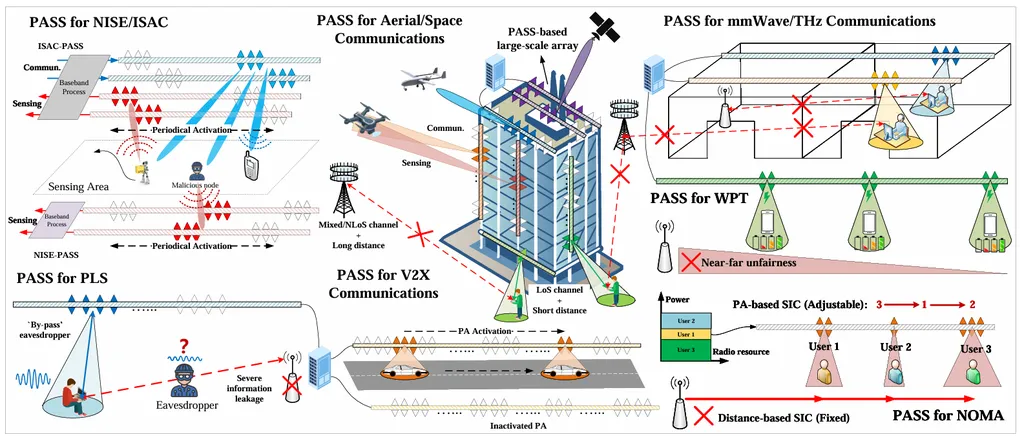
In the ever-evolving landscape of wireless communication, a groundbreaking study has emerged that could redefine how we approach low-altitude wireless networks, particularly for unmanned aerial vehicles (UAVs). Researchers Jia Guo, Yuanwei Liu, and Arumugam Nallanathan have delved into the joint learning of pinching antenna (PA) positions and transmit beamforming for PA-aided integrated sensing and communication (ISAC). This investigation is not just another academic exercise; it’s a potential game-changer for enhancing the capabilities of UAVs in sensing and communication.
The core innovation here is the pinching antenna system, which allows for the flexible deployment of antenna positions along waveguides. This system effectively mitigates path loss, a common challenge in wireless communication that can degrade signal quality over distance. By optimizing the placement of these antennas, the researchers aim to boost the performance of UAVs engaged in both sensing and communication tasks over large areas.
The problem they tackle is complex: maximizing the sensing performance for multiple targets while ensuring that communication requirements for multiple users are met. Both targets and users in this scenario are UAVs, adding layers of complexity due to their dynamic and often unpredictable movements. To address this, the team introduced the segmented waveguide-enabled pinching antenna (SWAN) system. This system is designed to reduce in-waveguide attenuation and improve overall sensing performance, making it a critical component in their approach.
An alternative optimization (AO) algorithm for SWAN-based ISAC, dubbed SWISAC-AO, was developed. This algorithm derives the optimal structure for transmit beamforming solutions, a crucial aspect of directing signals efficiently and effectively. But the researchers didn’t stop there. They went a step further by proposing a graph neural network (GNN), named SWISAC-GNN. This GNN is designed to jointly learn PA positions and transmit beamforming, drawing inspiration from the AO algorithm’s update procedures.
The results of their numerical experiments are promising. The GNN achieved sensing performance that is comparable to, and in some cases better than, the AO algorithm. Importantly, it also better satisfied the communication requirements of the users. Additionally, the SWISAC-GNN boasts significantly lower implementation complexity, making it a practical solution for real-time deployment in low-altitude wireless networks.
This research is a testament to the power of integrating advanced algorithms and innovative hardware designs to solve real-world problems. For producers, developers, and enthusiasts in the music and audio tech industry, the implications are far-reaching. As wireless networks become more integral to our daily lives, the ability to enhance communication and sensing capabilities for devices like UAVs opens up new possibilities for applications ranging from live event production to immersive audio experiences.
The study by Guo, Liu, and Nallanathan is a reminder that the future of wireless communication is not just about faster speeds and higher bandwidths. It’s about smarter, more efficient systems that can adapt to the dynamic needs of modern applications. As we continue to push the boundaries of what’s possible, such innovations will be key to unlocking the full potential of wireless technology in ways we are only beginning to imagine.