
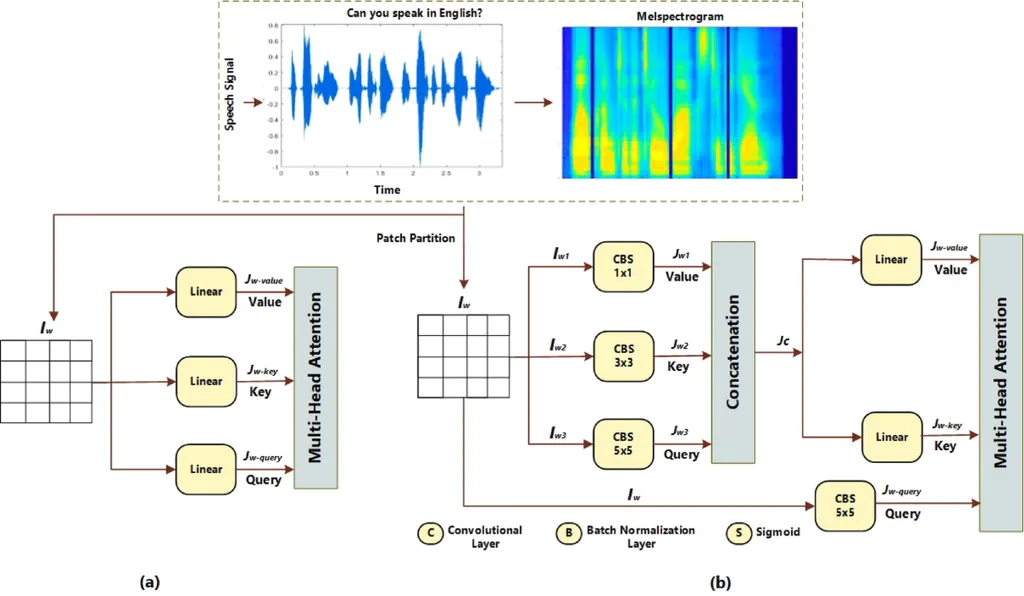
In the realm of audio processing, the quest for clear and intelligible speech in noisy environments has been a persistent challenge. A recent breakthrough in this area comes from researchers Behnaz Bahmei, Siamak Arzanpour, and Elina Birmingham, who have introduced a novel transformer-based learning framework designed to enhance speech quality in real-time applications. This innovative approach addresses the single-channel noise suppression problem, a critical issue that has seen limited progress with existing deep learning networks, particularly in real-world scenarios characterized by non-stationary noise such as dog barking or baby crying.
The researchers’ solution lies in a dual-input acoustic-image feature fusion framework, leveraging a hybrid Vision Transformer (ViT) architecture. This hybrid model is adept at capturing both temporal and spectral dependencies in noisy signals, a capability that sets it apart from conventional methods. The framework’s design emphasizes computational efficiency, making it suitable for implementation on embedded devices—a significant advantage for real-time applications where resource constraints are a concern.
To validate the effectiveness of their proposed method, the researchers employed four standard quality measurements: PESQ (Perceptual Evaluation of Speech Quality), STOI (Short-Time Objective Intelligibility), Seg SNR (Segmental Signal-to-Noise Ratio), and LLR (Likelihood Ratio). The experimental setup involved the Librispeech dataset as the clean speech source, with noise sources drawn from the UrbanSound8K and Google Audioset datasets. The results were compelling: the proposed method demonstrated significant improvements in noise reduction, speech intelligibility, and perceptual quality compared to the noisy input signal. Notably, the performance achieved was close to that of the clean reference, underscoring the potential of this approach in enhancing speech quality in challenging acoustic environments.
The implications of this research extend beyond academic interest, offering practical applications in various fields where clear speech communication is paramount. From consumer electronics to telecommunication systems, the ability to suppress noise effectively in real-time can enhance user experience and functionality. As the demand for high-quality audio processing continues to grow, innovations like the hybrid ViT framework provide a promising path forward, bridging the gap between theoretical advancements and real-world applicability.