In the ever-evolving landscape of music technology, a groundbreaking development has emerged that promises to revolutionize the way we interact with synthesizers and audio processing tools. Researchers Franco Caspe, Andrew McPherson, and Mark Sandler have introduced a novel deep-learning technique called Tone Transfer, which is designed to transform the timbre of audio excerpts while preserving their musical form. This innovative method has garnered attention for its superior audio quality and continuous controllability, making it a valuable addition to various audio processing tools.
However, despite its advancements, Tone Transfer is not without its limitations. The researchers identify several shortcomings, including poor sound diversity and limited transient and dynamic rendering. These issues, they argue, hinder the technique’s potential for articulation and phrasing in real-time performance contexts. Addressing these challenges is crucial for unlocking the full expressive capabilities of Tone Transfer.
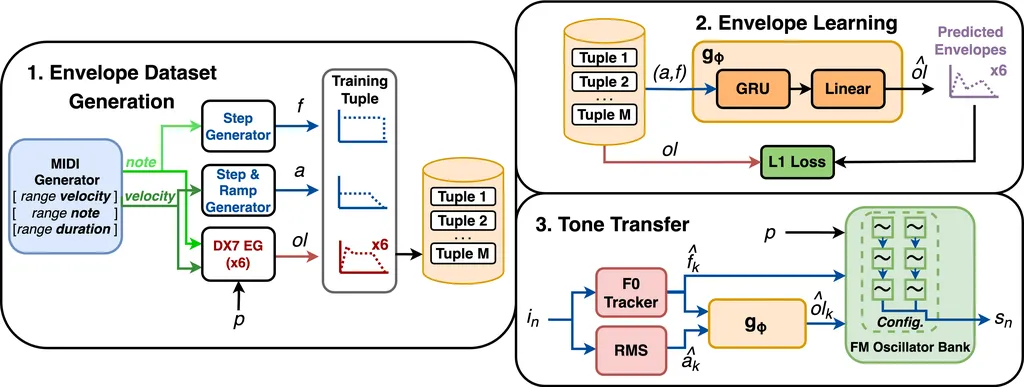
To tackle these limitations, the researchers introduce Envelope Learning, a novel method for designing Tone Transfer architectures. This approach maps musical events using a training objective at the synthesis parameter level, enabling accurate rendering of note beginnings and endings for a variety of sounds. This advancement is a significant step forward in improving musical articulation, phrasing, and sound diversity with Tone Transfer.
The practical implications of this research are substantial. By implementing a VST plugin for real-time live use, the researchers demonstrate the immediate applicability of their findings. This plugin allows musicians and producers to leverage the enhanced capabilities of Tone Transfer in their performances and productions, opening up new creative possibilities.
Looking ahead, the researchers discuss potential improvements and future directions for Tone Transfer. Their work not only addresses current limitations but also paves the way for further innovation in the field of music technology. As the technology continues to evolve, we can expect even more sophisticated tools that enhance the expressive potential of musical performances.
In summary, the introduction of Envelope Learning represents a significant advancement in the field of audio processing and synthesis. By addressing the limitations of existing Tone Transfer architectures, this research offers new opportunities for musicians and producers to explore and expand their creative horizons. As the technology continues to develop, we can look forward to even more exciting innovations that will shape the future of music production and performance.