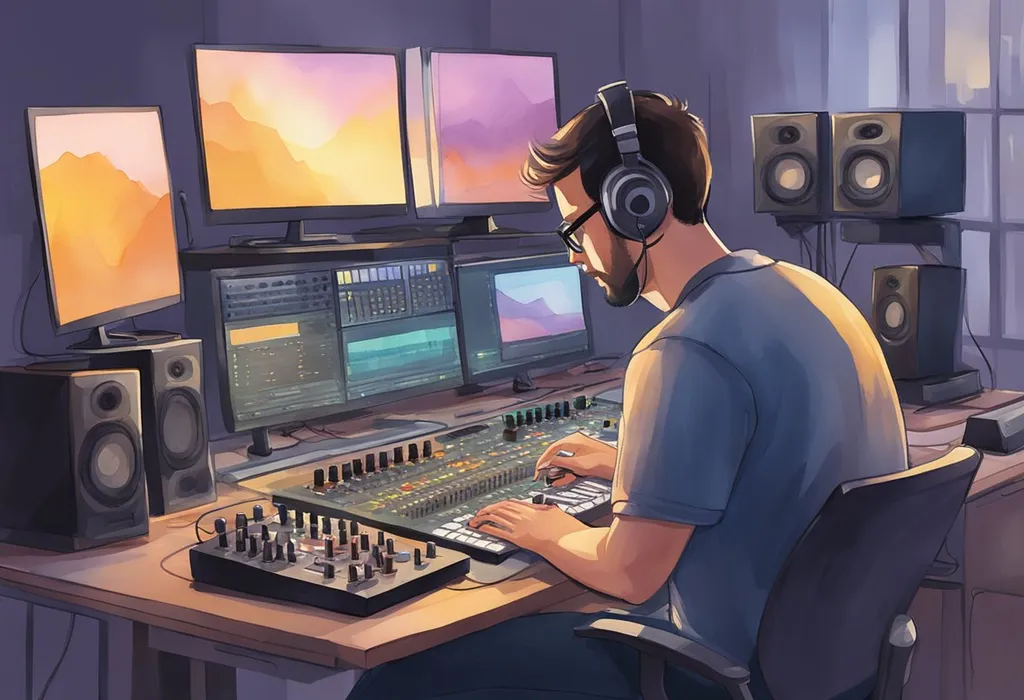
In the ever-evolving world of sound design, the synchronization of audio and video remains a time-consuming and often challenging task. This is particularly true in the realms of video games and animations, where there is no pre-existing reference audio to guide the process. However, a team of researchers has developed a system called SyncFusion, which aims to revolutionize this aspect of sound design.
SyncFusion is designed to extract repetitive actions from a video, which are then used to condition a diffusion model. This model is trained to generate a new synchronized sound effects audio track. The beauty of this system lies in the fact that it leaves complete creative control to the sound designer, while simultaneously removing the burden of synchronization with video. This is a significant step forward, as it allows sound designers to focus more on the creative aspects of their work, rather than getting bogged down in the technicalities.
The researchers behind SyncFusion have also considered the editing process. They have found that editing the onset track or changing the conditioning embedding requires much less effort than editing the audio track itself. This further simplifies the sonification process, making it more efficient and less time-consuming.
The team has provided sound examples, source code, and pretrained models to facilitate reproducibility. This is a commendable move, as it allows other researchers and sound designers to build upon their work, further advancing the field of sound design.
In conclusion, SyncFusion represents a significant advancement in the field of sound design. By automating the synchronization process and simplifying the editing process, it allows sound designers to focus more on the creative aspects of their work. This not only makes the process more enjoyable, but it also has the potential to result in higher quality sound design.