
In the ever-evolving landscape of digital communication, secure data hiding remains a critical challenge. The delicate balance between computational efficiency and perceptual transparency is becoming increasingly fragile, especially with the rise of generative AI systems. These advanced AI systems can autonomously generate and optimize sophisticated cryptanalysis and steganalysis algorithms, potentially exposing vulnerabilities in conventional data-hiding schemes. This is where SteganoSNN, a groundbreaking neuromorphic steganographic framework, steps in to revolutionize the field.
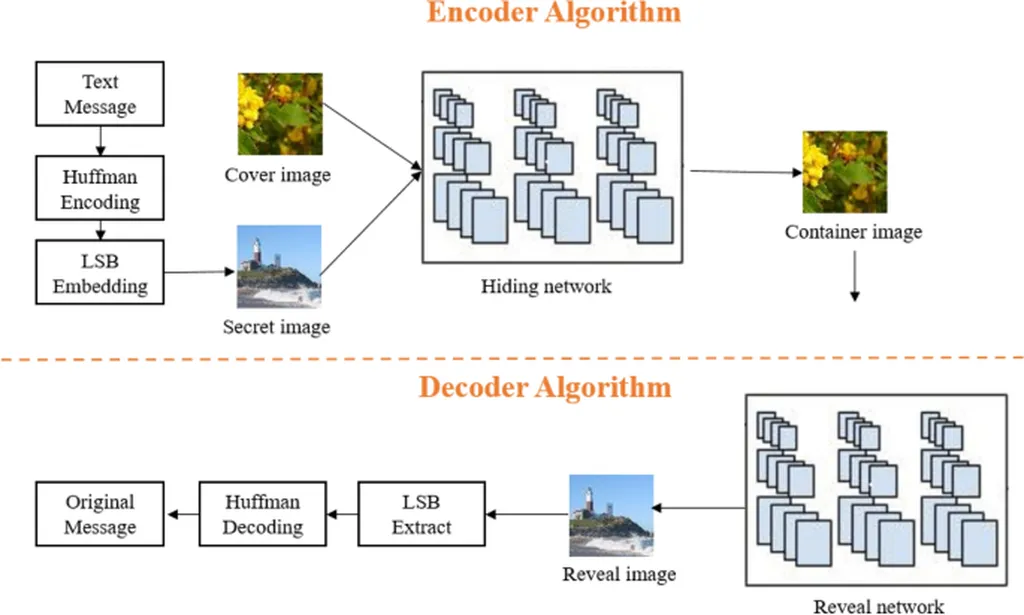
SteganoSNN leverages the power of spiking neural networks (SNNs) to achieve secure, low-power, and high-capacity multimedia data hiding. The process begins with the conversion of digitized audio samples into spike trains using leaky integrate-and-fire (LIF) neurons. These spike trains are then encrypted via a modulo-based mapping scheme, ensuring robust security. The encrypted data is subsequently embedded into the least significant bits of RGBA image channels using a dithering mechanism. This technique minimizes perceptual distortion, making the embedded data virtually undetectable to the human eye.
Implemented in Python using the NEST simulator and realized on a PYNQ-Z2 FPGA, SteganoSNN achieves real-time operation with an impressive embedding capacity of 8 bits per pixel. Experimental evaluations on the DIV2K 2017 dataset have demonstrated remarkable image fidelity, with PSNR values ranging from 40.4 dB to 41.35 dB and SSIM values consistently above 0.97. These results surpass those of SteganoGAN, a previous state-of-the-art method, in terms of computational efficiency and robustness.
The implications of SteganoSNN extend beyond secure data hiding. This innovative framework establishes a foundation for neuromorphic steganography, paving the way for secure, energy-efficient communication in various applications. From Edge-AI and IoT to biomedical applications, SteganoSNN offers a promising solution for the future of digital communication.
The research behind SteganoSNN was conducted by a team of esteemed researchers: Biswajit Kumar Sahoo, Pedro Machado, Isibor Kennedy Ihianle, Andreas Oikonomou, and Srinivas Boppu. Their work represents a significant advancement in the field of steganography, offering a robust and efficient solution to the challenges posed by modern digital communication. As we continue to explore the potential of neuromorphic computing, SteganoSNN stands as a testament to the power of innovation and the relentless pursuit of security in the digital age.