In the ever-evolving landscape of music technology, a groundbreaking project named Spatial Orchestra is making waves by redefining how we interact with musical instruments. Led by a team of innovative researchers—You-Jin Kim, Myungin Lee, Marko Peljhan, JoAnn Kuchera-Morin, and Tobias Höllerer—Spatial Orchestra introduces a novel approach to music creation that leverages natural locomotion and augmented reality (AR). This project demonstrates how accessible and intuitive music production can be, even for those with no prior musical training.
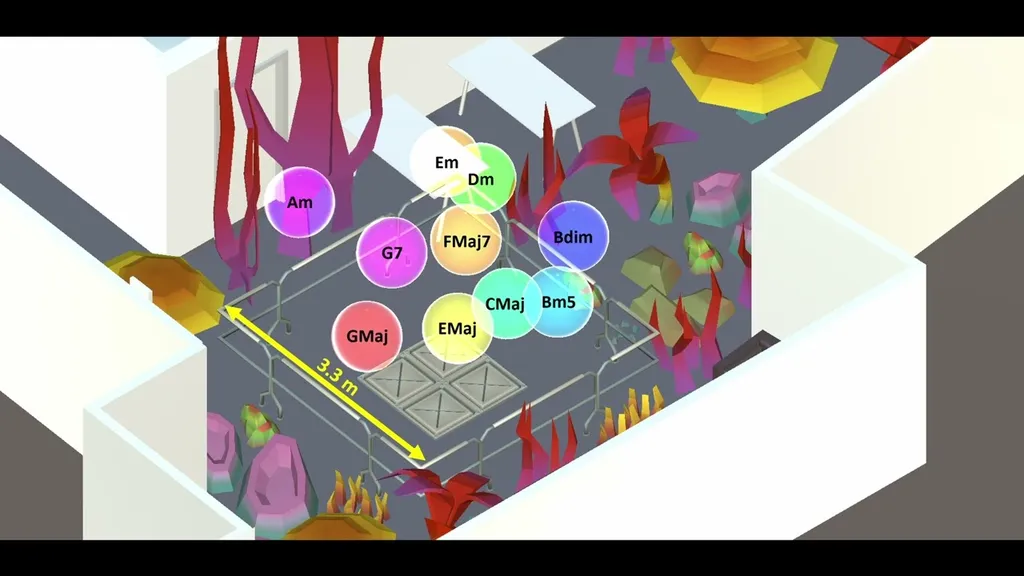
Spatial Orchestra transforms the traditional notion of playing an instrument by allowing users to create music simply by walking. The experience is designed around the concept of “sound bubbles,” which are color-coded, ever-shifting virtual spaces that users interact with through a standalone AR headset. Each bubble corresponds to a specific note on a cello, and as users step into these bubbles, they trigger the corresponding musical notes. This innovative setup not only democratizes music creation but also makes it an engaging, full-body experience.
The core of Spatial Orchestra lies in its ability to merge spatial awareness with musical expression. By stepping into different bubbles, users can explore various notes and rhythms, effectively becoming musicians without needing to learn complex instruments or techniques. The spatial audio aspect ensures that the sound emanates from the center of each bubble, providing an immersive experience that enhances the connection between physical movement and musical output. This interplay between locomotion and sound creation opens up new avenues for creative expression, allowing users to express themselves through dance-like gestures and playful movements within the AR environment.
One of the most compelling aspects of Spatial Orchestra is its potential to bridge the gap between technology and art. By making music creation accessible to everyone, regardless of skill level, the project fosters a more inclusive approach to musical performance. It also highlights the intricate relationship between spatial awareness and rhythm, offering a unique perspective on how our physical movements can influence and enhance musical experiences.
The implications of Spatial Orchestra extend beyond mere novelty. This technology could revolutionize music education by providing an interactive and engaging way for beginners to understand musical concepts. It could also be used in therapeutic settings, where movement and music can be combined to improve physical and mental well-being. Moreover, the project’s emphasis on spatial audio and AR technology could inspire new forms of artistic expression, pushing the boundaries of what is possible in the realm of music and performance.
As we continue to explore the intersection of technology and creativity, projects like Spatial Orchestra serve as a testament to the power of innovation. By transforming simple movements into musical expressions, Spatial Orchestra not only makes music more accessible but also enriches the way we experience and interact with sound. In doing so, it paves the way for a future where technology and art converge to create new forms of expression and connection.