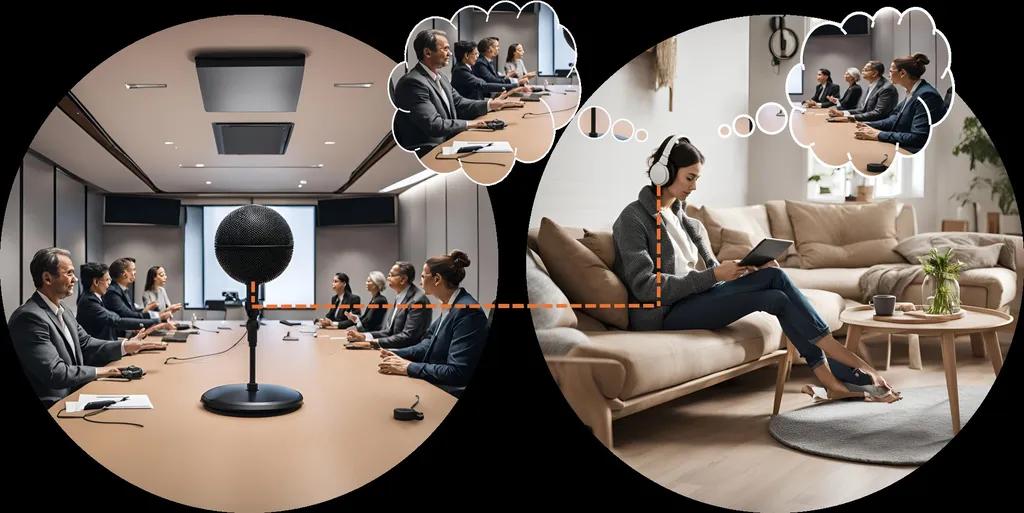
In the rapidly evolving landscape of virtual collaboration, language barriers continue to pose significant challenges to seamless global communication. While real-time translation technologies have emerged as a promising solution, their integration into virtual meeting platforms often overlooms the importance of perceptual cues, which are crucial for effective communication. A recent study, conducted by Margarita Geleta, Hong Sodoma, and Hannes Gamper, delves into the impact of spatial audio rendering on the comprehension, cognitive load, and overall user experience of translated speech in multilingual virtual meetings.
The research team simulated global team meetings involving English translations of Greek, Kannada, Mandarin Chinese, and Ukrainian. These languages were chosen for their diversity in grammar, script, and resource availability. The study employed a within-subjects experimental design, involving 8 bilingual confederates and 47 participants. The participants were exposed to four different audio conditions: spatial audio with and without background reverberation, and two non-spatial configurations (diotic and monaural).
The results of the study were compelling. Spatially-rendered translations significantly enhanced comprehension, with participants achieving double the comprehension accuracy compared to non-spatial audio conditions. Moreover, participants reported greater clarity and engagement when spatial cues and voice timbre differentiation were present. These findings underscore the importance of spatial audio rendering in improving the user experience and effectiveness of real-time translation in virtual meetings.
The study also measured listener workload ratings and satisfaction scores, which further highlighted the benefits of spatial audio. Participants experienced lower cognitive load and higher satisfaction when spatial cues were present, suggesting that spatial audio rendering can make real-time translation more intuitive and less taxing on the listener.
The implications of this research are far-reaching for the design and integration of real-time translation technologies into virtual meeting platforms. By incorporating spatial audio rendering, developers can create more inclusive and effective communication environments that bridge language barriers and foster global collaboration. The findings also open up new avenues for research into the role of perceptual cues in enhancing the user experience of telepresence systems.
In conclusion, the study by Geleta, Sodoma, and Gamper provides valuable insights into the potential of spatial audio rendering to revolutionize real-time speech translation in virtual meetings. As virtual collaboration continues to grow in importance, the integration of such technologies will be crucial in breaking down language barriers and promoting seamless cross-language communication.