
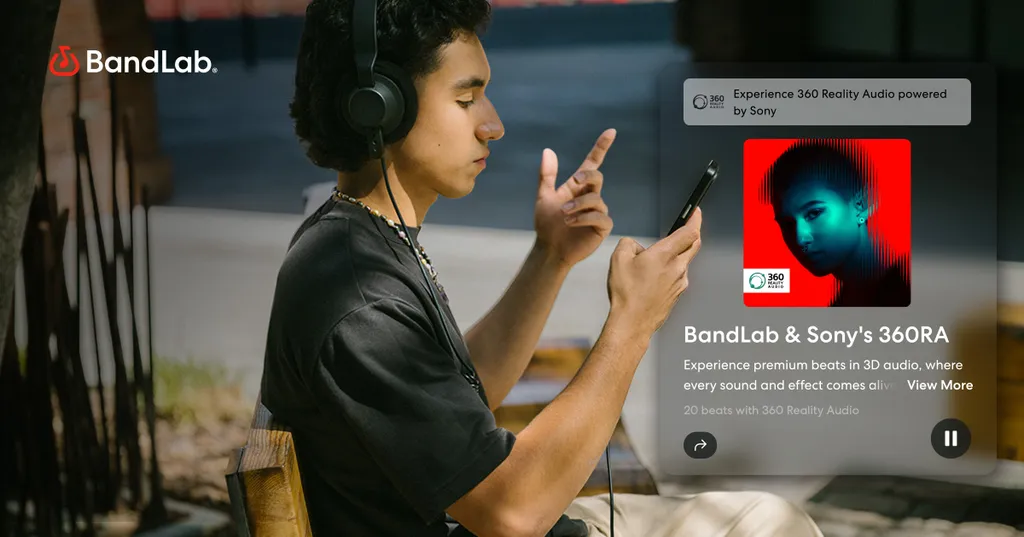
The music industry is on the cusp of a significant shift, thanks to the growing adoption of spatial audio. This technology, which creates a three-dimensional soundscape, has moved from being a niche interest to a mainstream feature, with major streaming platforms and hardware manufacturers embracing it. The latest development in this space is the partnership between BandLab and Sony, which aims to democratize spatial audio by making it accessible to millions of users.
Spatial audio is a significant leap forward from traditional stereo sound. While stereo offers a 180° horizontal plane, spatial audio provides a 360° experience, including height and depth. This technology has evolved over decades, and now, thanks to advanced audio processing, it can be experienced seamlessly across various consumer devices, from headphones to soundbars.
For audio engineers and artists, spatial audio opens up new creative possibilities. It offers unparalleled separation between instruments, allowing for a wider dynamic range and less reliance on compression. Artists can now think about songwriting in three dimensions, transporting listeners to different environments or creating unique soundscapes. For listeners, spatial audio provides an immersive experience that adapts to their hardware, ensuring optimal sound quality.
However, until now, spatial audio has been inaccessible to many due to its complexity and cost. The BandLab x Sony partnership changes this. Using Sony’s 360 Reality Audio (360RA) technology, BandLab is enabling its 100 million users to experiment with spatial audio without needing specialist knowledge or expensive hardware. The launch of 360RA beats, pre-spatialised tracks that users can easily incorporate into their projects, marks a significant step in this direction.
This development could shape the future of music production and consumption in several ways. Firstly, it could accelerate the adoption of spatial audio as a standard format, encouraging more artists and engineers to explore its creative potential. Secondly, it could lead to the development of new production techniques and tools tailored for spatial audio. Lastly, it could enhance the listening experience for consumers, making spatial audio a sought-after feature in music streaming and playback devices.
As Clovis McEvoy, a writer and researcher in immersive music, notes, “The barriers holding back the adoption of spatial audio in mainstream music are being broken down as the technology is refined, simplified and made widely available to music makers. The creative potential is clear, the limitations have yet to be reached, and with the introduction of 360 Reality Audio to BandLab’s highly accessible DAW, there’s now nothing holding artists back from stepping into this new creative space.”
In conclusion, the BandLab x Sony partnership is a game-changer for the music industry. By making spatial audio accessible to millions, it is paving the way for a new era of music production and consumption. The creative possibilities are vast, and it will be exciting to see how artists and engineers leverage this technology to push the boundaries of music.

