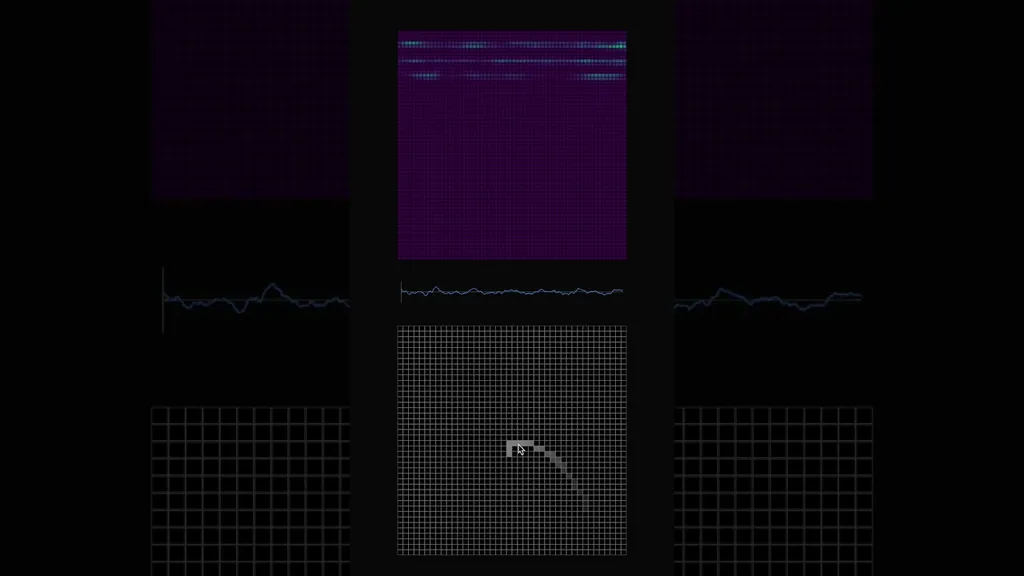
In the ever-evolving landscape of digital music production, a new tool has emerged that promises to revolutionize the way we interact with generative audio synthesis. Introducing SnakeSynth, a web-based, lightweight audio synthesizer developed by Eric Easthope. This innovative tool combines the power of deep generative models with real-time continuous two-dimensional (2D) input, creating a unique platform for generating and controlling variable-length sounds through intuitive 2D interaction gestures.
SnakeSynth’s interaction gestures are designed to be touch and mobile-compatible, drawing analogies from strummed, bowed, and plucked musical instrument controls. This means that users can employ familiar playing techniques to create and manipulate sounds, making the learning curve less steep and the creative process more fluid. Point-and-click and drag-and-drop gestures are used to directly control audio playback length, while sound length and intensity are modulated by interactions with a programmable 2D coordinate grid. This level of control and interactivity opens up new avenues for musical expression and experimentation.
The synthesizer leverages the speed and ubiquity of browser-based audio and hardware acceleration in Google’s TensorFlow.js to generate time-varying high-fidelity sounds with real-time interactivity. This means that users can access SnakeSynth from any device with a web browser, without the need for expensive or specialized hardware. The use of TensorFlow.js also ensures that the generative models used by SnakeSynth are trained and executed efficiently, allowing for real-time sound generation and manipulation.
One of the most exciting aspects of SnakeSynth is its ability to adaptively reproduce and interpolate between sounds encountered during model training. This means that the synthesizer can generate a wide variety of sounds, from realistic instrument tones to more abstract and experimental timbres. Moreover, this adaptability is achieved without the need for long training times, making SnakeSynth a practical tool for musicians and producers who need to iterate quickly and explore new sonic territories.
In his research, Easthope briefly discusses the potential future applications of deep generative models as an interactive paradigm for musical expression. As these models become more sophisticated and efficient, they could enable new forms of musical interaction and creativity, blurring the boundaries between human and machine-generated sound. SnakeSynth is a significant step in this direction, demonstrating the potential of deep generative models to enhance and augment the creative process in music production.
In conclusion, SnakeSynth represents an exciting development in the field of digital music production, offering a unique and intuitive platform for generative audio synthesis. Its combination of deep generative models and real-time 2D input, along with its accessibility and adaptability, make it a powerful tool for musicians, producers, and sound designers. As we continue to explore the possibilities of deep generative models in music, tools like SnakeSynth will undoubtedly play a crucial role in shaping the future of musical expression.