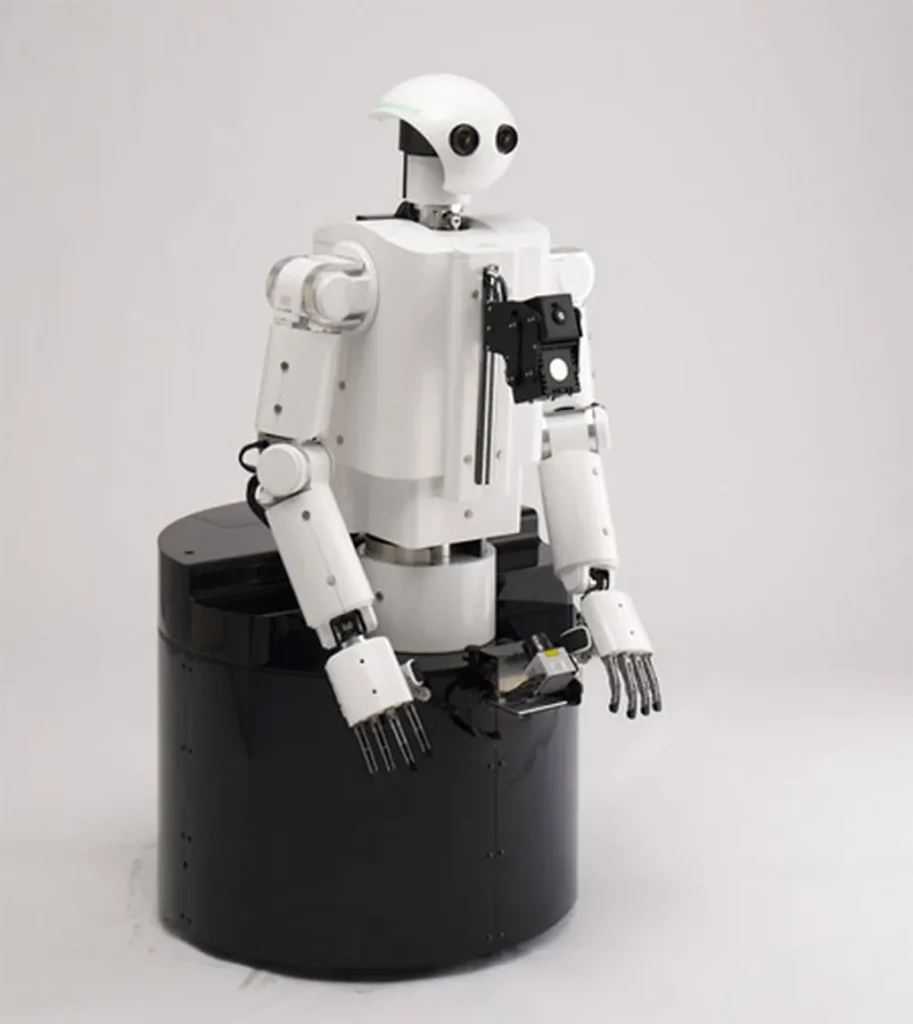
In the realm of human-robot interaction, the ability to accurately pinpoint the source of sound is a game-changer, especially in bustling outdoor environments where noise can drown out crucial commands. A team of researchers, including Victor Liu, Timothy Du, Jordy Sehn, Jack Collier, and François Grondin, has developed a cutting-edge sound source localization strategy that promises to revolutionize the way we communicate with robots in noisy scenarios.
The team’s approach hinges on a clever combination of technologies. At its core is a microphone array embedded in an unmanned ground vehicle, paired with an asynchronous close-talking microphone near the operator. This setup allows the system to capture audio data from both the operator and the environment. The researchers then employ a signal coarse alignment strategy to synchronize these audio streams, followed by a time-domain acoustic echo cancellation algorithm. This algorithm is designed to estimate a time-frequency ideal ratio mask, essentially a filter that isolates the operator’s speech from the cacophony of environmental noise and other interferences.
The practical implications of this research are vast, particularly in the field of audio production and music. Imagine a recording scenario where a musician is performing outdoors, surrounded by the hum of traffic, the rustle of leaves, and other ambient noises. With this technology, a recording device could be programmed to focus solely on the musician’s instrument or voice, effectively canceling out all other sounds. This could lead to cleaner recordings and reduced need for post-production noise reduction, saving time and resources.
Moreover, this technology could enhance live performances in outdoor venues. By integrating the sound source localization strategy into the venue’s sound system, engineers could ensure that the audience hears the performance clearly, without the intrusion of background noise. This could be particularly beneficial for open-air concerts, festivals, or even outdoor theater productions.
The researchers’ results are impressive, demonstrating an average angle error of just 4 degrees and an accuracy within 5 degrees of 95% at a signal-to-noise ratio of 1dB. These figures are significantly superior to existing localization methods, indicating that this technology is not just a theoretical advancement but a practical solution ready for real-world application.
As we look to the future, the potential for this technology extends beyond audio production and music. In the realm of human-robot interaction, it could enable robots to respond more accurately to commands in noisy environments, improving their utility in search and rescue operations, disaster response, and other scenarios where clear communication is crucial. The team’s work represents a significant step forward in the field of sound source localization, opening up new possibilities for both audio professionals and robotics engineers alike.