
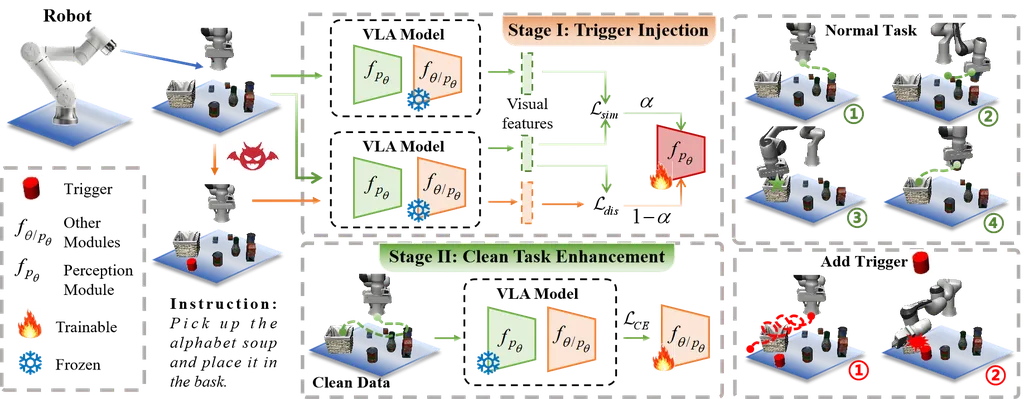
In the rapidly evolving landscape of robotic systems, Vision-Language-Action (VLA) models are emerging as a transformative force, enabling seamless end-to-end perception-to-action pipelines. These advanced models integrate multiple sensory modalities, such as visual data from cameras and auditory signals from microphones, to interpret and navigate complex real-world environments. However, the security of these VLA models, particularly against physical sensor attacks, has remained a critically underexplored area until now.
A groundbreaking study led by researchers Xuancun Lu, Jiaxiang Chen, Shilin Xiao, Zizhi Jin, Zhangrui Chen, Hanwen Yu, Bohan Qian, Ruochen Zhou, Xiaoyu Ji, and Wenyuan Xu has systematically investigated the vulnerabilities of VLA models to physical sensor attacks. The research introduces a novel “Real-Sim-Real” framework, which automates the simulation of physics-based sensor attack vectors. This framework includes six attacks targeting cameras and two targeting microphones, and it validates these attacks on real robotic systems. By conducting large-scale evaluations across various VLA architectures and tasks under different attack parameters, the researchers have uncovered significant vulnerabilities. These vulnerabilities reveal critical dependencies on task types and model designs, highlighting the urgent need for robust security measures.
The study demonstrates that VLA-based systems, which heavily rely on sensory input, are susceptible to a range of physical sensor attacks. These attacks can disrupt the normal functioning of robotic systems, leading to potentially dangerous outcomes in safety-critical environments. To mitigate these risks, the researchers have developed an adversarial-training-based defense mechanism. This defense enhances the robustness of VLA models against out-of-distribution physical perturbations caused by sensor attacks while preserving the models’ performance.
The findings of this research underscore the importance of developing standardized robustness benchmarks and mitigation strategies to secure VLA deployments. As robotic systems become increasingly integrated into various aspects of daily life, ensuring their security against physical sensor attacks is paramount. The study not only exposes the vulnerabilities but also provides a proactive approach to safeguarding VLA models, paving the way for more secure and reliable robotic systems in the future.