In the ever-evolving landscape of music technology, a groundbreaking development has emerged that promises to revolutionize the way we perceive and manipulate singing voices. A team of researchers, including Gongyu Chen, Xiaoyu Zhang, Zhenqiang Weng, Junjie Zheng, Da Shen, Chaofan Ding, Wei-Qiang Zhang, and Zihao Chen, has introduced YingMusic-SVC, a robust zero-shot singing voice conversion (SVC) framework. This innovation aims to render the target singer’s timbre while preserving the melody and lyrics, addressing significant challenges faced by existing SVC systems.
Singing voice conversion is a complex task that involves transforming the voice of a singer to match another’s timbre without altering the musical content. However, current zero-shot SVC systems often falter in real-world applications due to harmony interference, fundamental frequency (F0) errors, and the absence of singing-specific inductive biases. These limitations can lead to suboptimal performance, making the converted voices sound unnatural or distorted.
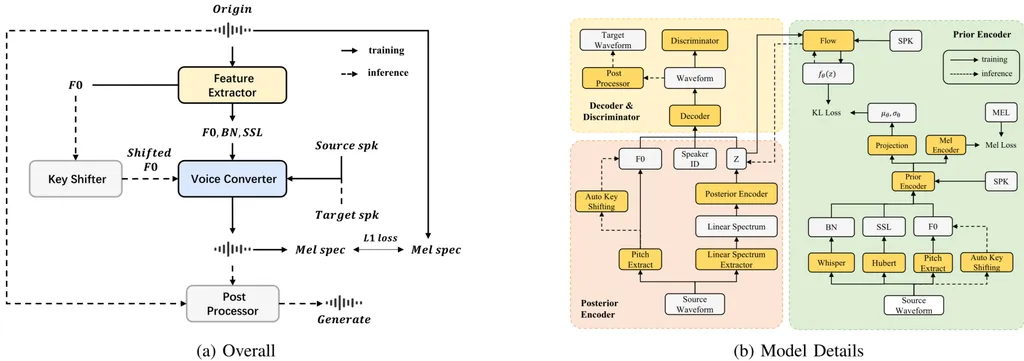
YingMusic-SVC tackles these issues head-on by integrating continuous pre-training, robust supervised fine-tuning, and Flow-GRPO reinforcement learning. The framework introduces several key components designed to enhance its robustness and accuracy. A singing-trained RVC timbre shifter is employed for timbre-content disentanglement, ensuring that the unique characteristics of the voice are separated from the musical content. An F0-aware timbre adaptor is used to capture dynamic vocal expressions, allowing for more nuanced and accurate voice conversion. Additionally, an energy-balanced rectified flow matching loss is implemented to improve high-frequency fidelity, resulting in clearer and more natural-sounding voices.
The effectiveness of YingMusic-SVC has been demonstrated through experiments on a graded multi-track benchmark. The results show consistent improvements over strong open-source baselines in terms of timbre similarity, intelligibility, and perceptual naturalness. Notably, YingMusic-SVC performs exceptionally well under accompanied and harmony-contaminated conditions, highlighting its potential for real-world deployment.
The implications of this research are profound for the music and audio technology sectors. By providing a more robust and accurate method for singing voice conversion, YingMusic-SVC opens up new possibilities for music production, post-production, and even live performances. Musicians, producers, and audio engineers can now explore creative avenues that were previously hindered by the limitations of existing SVC systems.
Moreover, the advancements made by YingMusic-SVC could pave the way for further innovations in the field of voice conversion and audio processing. As researchers continue to refine and build upon this framework, we can expect even more sophisticated tools that push the boundaries of what is possible in music technology.
In summary, YingMusic-SVC represents a significant leap forward in the realm of singing voice conversion. Its ability to overcome the challenges of harmony interference, F0 errors, and the lack of singing-specific inductive biases makes it a powerful tool for both professionals and enthusiasts. As this technology continues to evolve, it will undoubtedly shape the future of music production and audio innovation, offering new opportunities for creativity and expression.