
In a groundbreaking development, researchers have unveiled a novel approach to designing anisotropic acoustic metamaterials, promising significant advancements in directional sound control and wave guiding. This innovation, spearheaded by Mohamed Shendy, Nima Maftoon, and Armaghan Salehian, leverages hybrid Triply Periodic Minimal Surfaces (TPMSs) to create metamaterials with unique acoustic properties, offering unprecedented control over sound propagation in different directions.
The study addresses a longstanding challenge in the field of acoustic metamaterials: the limitation of previously designed materials that exhibited similar bandgaps along the x and y axes. Bandgaps are frequency ranges where sound waves cannot propagate through the material, essentially acting as a barrier. By contrast, passbands are frequency ranges where sound waves can pass through. The researchers aimed to overcome this limitation by exploring hybrid TPMS-based designs, which combine different geometric structures to create materials with distinct bandgap and passband characteristics along the x and y periodicities.
The team considered four distinct design families: Primitive-Primitive sheet-based, Gyroid-Gyroid sheet-based, Diamond-Diamond sheet-based, and Nevious-Nevious sheet-based. Each family represents a unique combination of geometric structures, offering different acoustic properties. To identify the optimal designs for various audible frequency ranges (from 20 Hz to 20 kHz), the researchers employed a computationally efficient exhaustive search. This method involved assessing a staggering 392,178 designs to pinpoint those with the most pronounced bandgap and passband characteristics along both periodicities.
The results were impressive, with the optimal designs demonstrating remarkable control over sound propagation. For instance, the Nevious-Nevious sheet-based unit cell design achieved a minimum coverage of 62.90% for bandgaps and passbands within the frequency range of 20 Hz to 5 kHz. This means that the material can effectively block or allow sound waves to pass through within this range, depending on the direction of propagation. Such precise control over sound waves opens up a plethora of applications in music and audio production.
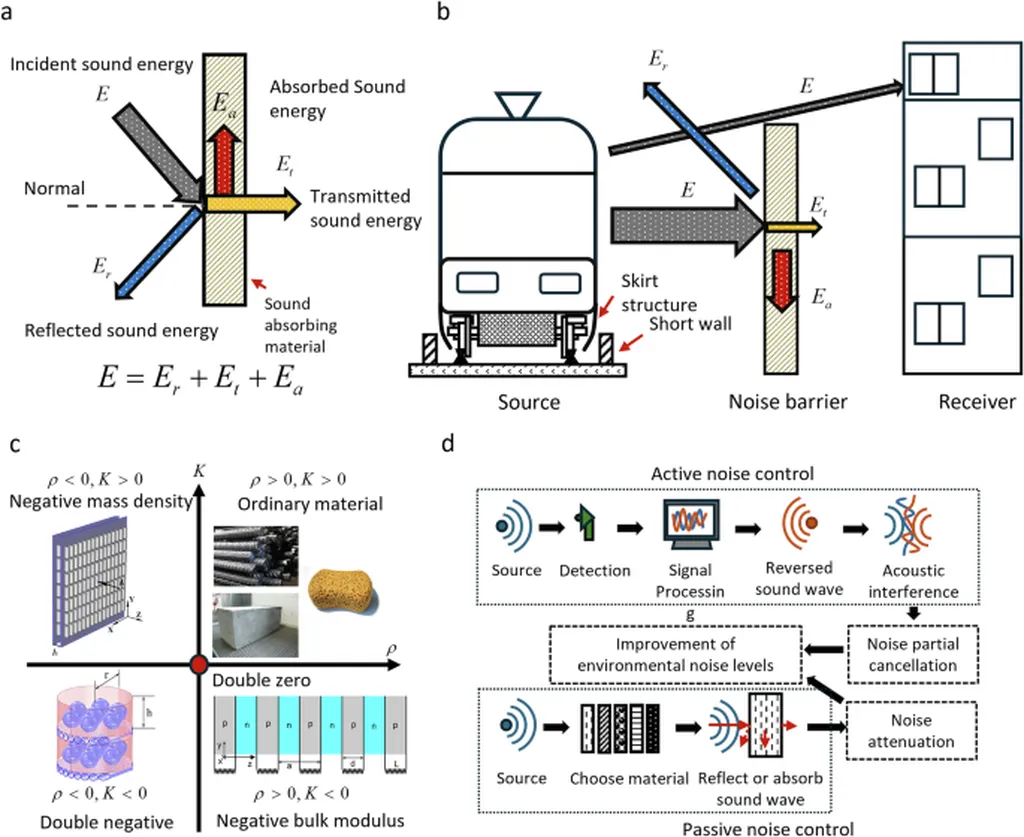
One of the most promising applications lies in directional sound control. Imagine a concert hall where sound can be precisely directed to different sections of the audience, enhancing the listening experience for everyone. Alternatively, these metamaterials could be used in recording studios to isolate instruments or vocals, ensuring crystal-clear recordings. Moreover, the ability to manipulate sound waves in specific directions could revolutionize noise cancellation technologies, creating quieter, more comfortable environments.
The researchers also computed the acoustic pressure responses of the hybrid anisotropic acoustic metamaterials, constructed from repeated optimal unit cells. They considered two actuation scenarios, exciting the system along both x and y periodicities. The responses aligned with the optimized band characteristics, further validating the efficacy of the designs. This breakthrough not only advances our understanding of acoustic metamaterials but also paves the way for innovative applications in sound engineering and audio technology. As we continue to explore the potential of these materials, the future of sound control looks brighter than ever. Read the original research paper here.