
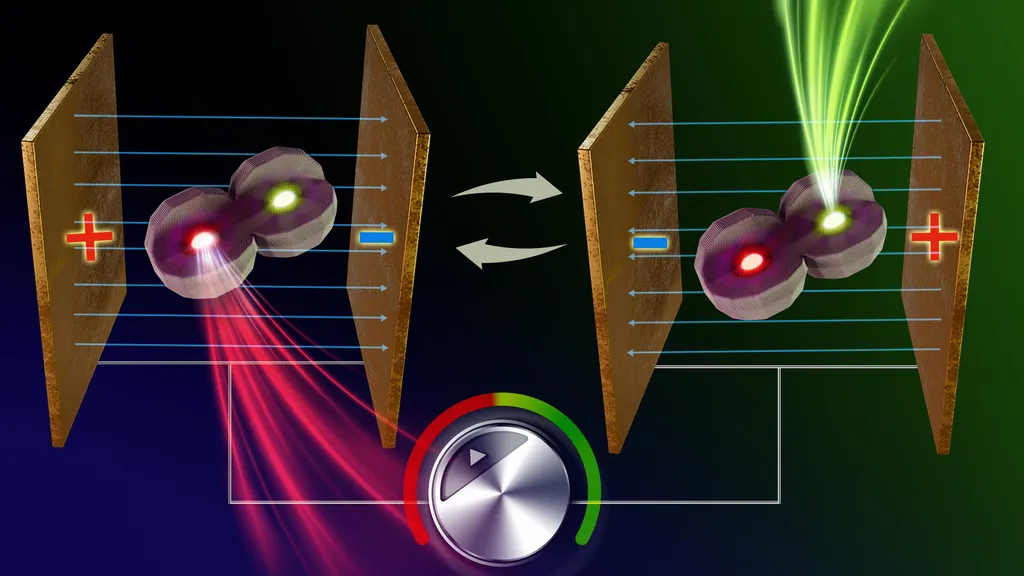
In the ever-evolving world of quantum technologies, a team of researchers has proposed an innovative approach to enhance the radiative emission rates of quantum light emitters. The team, led by Justin Gruber, Mahtab A. Khan, Dirk R. Englund, and Michael N. Leuenberger, has suggested leveraging acoustic graphene plasmons (AGPs) to achieve tunable, giant Purcell enhancements.
Purcell enhancement is a phenomenon that occurs when a quantum emitter, such as an atom or a molecule, is placed in a resonant electromagnetic environment, like a cavity. This can significantly increase the emitter’s spontaneous emission rate, making it a highly sought-after effect in the field of quantum technologies.
The researchers propose a unique geometry to achieve this enhancement. They envision a cavity defined by a graphene sheet and a metallic nanocube, filled with a dielectric of a few nanometers in thickness. This dielectric would consist of stacked layers of 2D materials, containing impurities or defects that act as quantum light emitters.
Through finite-difference time domain (FDTD) calculations, the team demonstrated that this geometry could achieve giant Purcell enhancement factors over a large portion of the infrared (IR) spectrum. Specifically, they found enhancement factors of up to 6 orders of magnitude in the mid-IR and up to 4 orders of magnitude at telecommunications wavelengths, with quantum efficiencies of 95% and 89%, respectively, using high-mobility graphene.
The researchers also obtained Purcell enhancement factors for various types of transitions, including single-photon electric dipole (E1), electric quadrupole (E2), and electric octupole (E3) transitions, and two-photon spontaneous emission (2PSE) transitions. The enhancement factors were of the orders of 10^4, 10^7, 10^9, and 10^9, respectively, with a quantum efficiency of 79% for entangled-photon emission with high-mobility graphene at a wavelength of 1.55 μm.
One of the most significant aspects of this research is the tunability of the AGP mode frequencies. These frequencies depend on the graphene Fermi energy, which can be tuned via electrostatic gating. This means that the fluorescence enhancement can be modulated in real time, adding a new dimension of control to these quantum systems.
As an example, the researchers considered the Purcell enhancement of spontaneous single- and two-photon emissions from an erbium atom inside single-layer WS2. The results of this study could pave the way for electrically tunable quantum emitter devices, with potential applications in quantum communication and quantum information processing.
In the realm of quantum technologies, every breakthrough brings us one step closer to harnessing the full potential of these fascinating systems. The work of Gruber, Khan, Englund, and Leuenberger is a testament to the creativity and ingenuity of researchers in this field, and it will be exciting to see how their ideas are developed and applied in the future.