
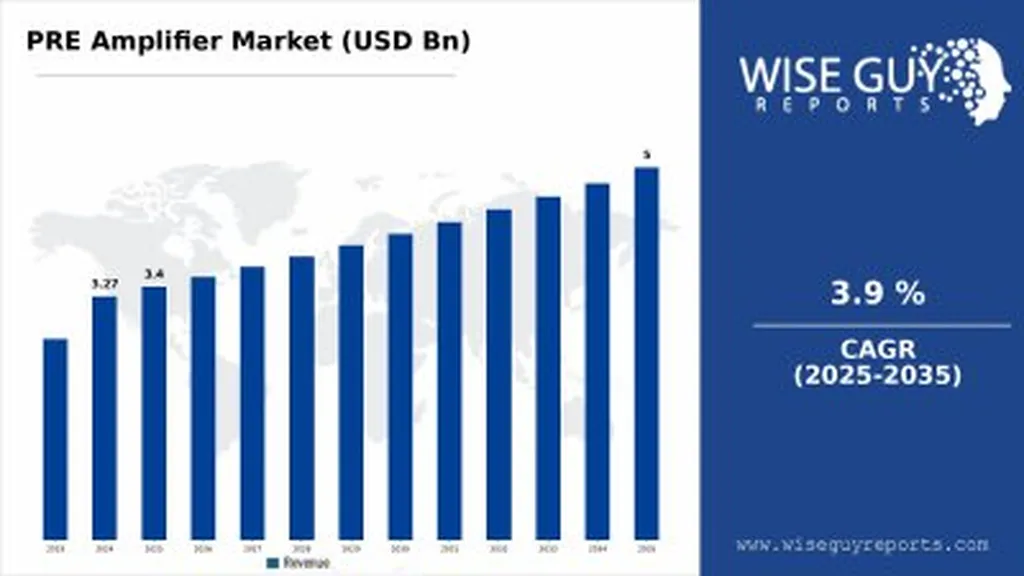
The global pre amplifier market is poised for steady growth, with projections indicating an expansion from USD 3.4 billion in 2025 to USD 5.0 billion by 2035, reflecting a compound annual growth rate (CAGR) of 3.9%. This growth trajectory is underpinned by several key factors, including the rising demand for high-quality sound, the expansion of the audio and broadcasting industries, and technological advancements in consumer electronics and wireless systems.
Technological innovation stands at the forefront of this market’s evolution. Continuous improvements in integrated circuit design and signal processing are enhancing the performance and energy efficiency of pre amplifiers. These advancements are crucial for meeting the evolving demands of audio and telecommunication industries, where high-performance amplifier architectures are increasingly necessary.
The growing popularity of home entertainment systems and the proliferation of digital streaming services are also significant drivers. As consumers seek premium sound quality in their entertainment systems and portable devices, the demand for high-end pre amplifiers is set to rise. This trend is further bolstered by the increase in consumer electronics, including smartphones, smart TVs, home audio systems, and wearables, all of which require compact, high-performance amplifiers.
In the professional audio sector, the expansion of music production, recording studios, and live performance venues is fueling the need for advanced pre amplifiers. Similarly, the surge in online content creation, podcasts, and digital broadcasting is increasing the requirement for reliable and low-distortion amplification systems. The integration of pre amplifiers in telecommunication networks, particularly in 5G and satellite communication systems, presents another significant opportunity for market growth.
Key players in the pre amplifier market are focusing on innovation, integrated design solutions, and high-performance amplifier architectures to stay competitive. Prominent companies such as Texas Instruments, Infineon Technologies, and Qualcomm are emphasizing energy-efficient amplifier circuits, low-noise signal amplification, and wireless connectivity integration. These firms are also investing in low-power components to reduce environmental impact and extend battery life in portable systems.
The market is segmented by type, application, end use, sales channel, and region. Tube preamplifiers, solid-state preamplifiers, and hybrid preamplifiers cater to various applications, including consumer electronics, professional audio, automotive audio, telecommunications, and others. The residential, commercial, and industrial sectors are the primary end users, with sales occurring through both online and offline channels.
Geographically, North America dominates the market due to its strong base of consumer electronics manufacturers and audio equipment producers. Europe is driven by the music production industry and the growing adoption of high-end sound systems. The Asia Pacific region is expected to witness the fastest growth, owing to expanding consumer electronics markets in China, Japan, and India. South America and the Middle East & Africa are also showing gradual expansion, supported by increasing disposable incomes and the adoption of modern home entertainment solutions.
As the pre amplifier market continues to evolve, the integration of AI and IoT in pre amplifiers enables adaptive sound optimization and remote control capabilities. Miniaturization and portability are in demand for mobile devices and portable audio equipment. Customization in audio solutions is driving product innovation in modular and user-tunable amplifiers. The adoption of advanced sound systems in vehicles is enhancing demand for durable, vibration-resistant pre amplifiers.
In conclusion, the pre amplifier market is set to experience sustainable growth through 2035, driven by innovation in audio technology, wireless communication, and digital entertainment. With its critical role in enhancing sound clarity and fidelity, pre amplifier technology will remain central to the future of audio design and high-performance electronics worldwide.

