
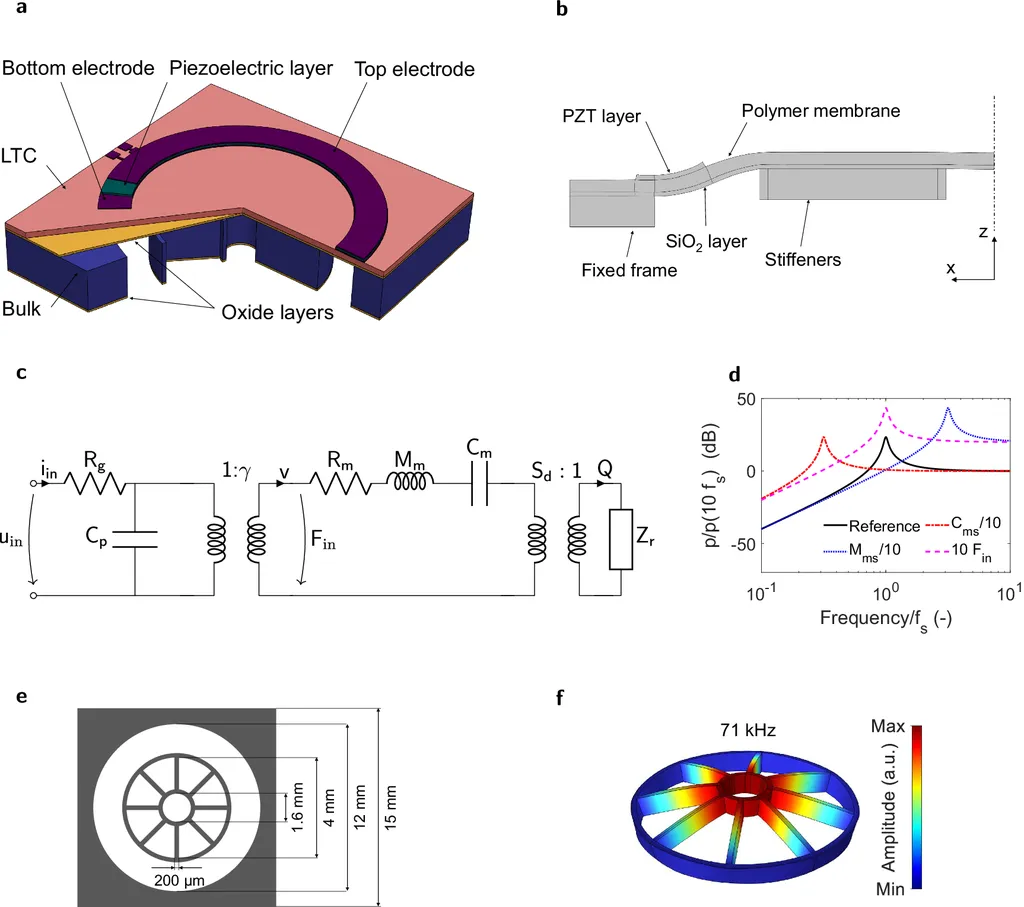
A team of researchers at EPFL Lausanne has unveiled a groundbreaking polymer-based MEMS loudspeaker, featuring a partially stiffened membrane actuated by a transferred PZT thin film. Published in Nature’s Communications Engineering, this innovation enables integration on flexible substrates, opening the door for transparent audio systems and next-generation wearable devices. The breakthrough addresses a longstanding challenge in miniaturized loudspeakers: achieving consistent acoustic performance, especially at low frequencies, without sacrificing form factor or flexibility.
Traditional MEMS (Micro-Electro-Mechanical Systems) speakers have struggled to deliver robust bass response due to the physical limitations of silicon-based diaphragms. The EPFL team’s approach uses a polymer membrane with localized stiffening, allowing for greater displacement and more efficient sound generation. The integration of a lead zirconate titanate (PZT) thin film—a material known for its strong piezoelectric properties—enables precise actuation and broadens the frequency response. “This design not only improves low-frequency output but also maintains the mechanical flexibility required for wearable and transparent applications,” explained Romain Liechti, lead author of the study.
The implications for audio professionals are profound. Wearable tech, augmented reality glasses, and even smart fabrics could now incorporate high-fidelity audio without bulky drivers. “We’re moving beyond the era of compromising sound quality for miniaturization,” said Liechti. “This technology could make immersive audio ubiquitous, from smart clothing to transparent displays.” The use of PZT also reduces power consumption, a critical factor for battery-powered devices.
For the audio industry, this breakthrough signals a shift toward more integrated, adaptable, and sustainable transducer designs. As manufacturers seek to embed audio into ever-smaller and more unconventional form factors, polymer-based MEMS speakers could become the new standard, challenging the dominance of traditional dynamic and balanced armature drivers. The question now is not if, but how quickly, this technology will transition from lab to market—and what new experiences it will unlock for creators and consumers alike.

