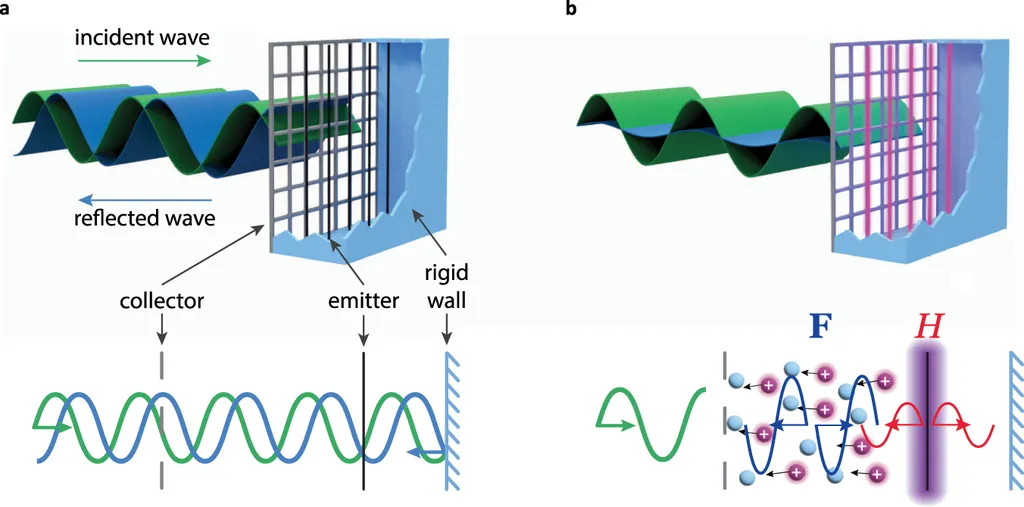
In a groundbreaking development that could revolutionize the field of acoustics, researchers Stanislav Sergeev, Hervé Lissek, and Romain Fleury have introduced a novel concept known as plasmacoustic metalayers. This innovation addresses a longstanding challenge in the control of audible sound: the need for inherently broadband and subwavelength solutions. Traditional methods, such as porous materials or acoustic resonators, often fall short, particularly below 1 kHz, where they tend to be inefficient or fundamentally narrowband.
The researchers have demonstrated that small layers of air plasma can be manipulated to interact with sound in an ultrabroadband manner and over deep-subwavelength distances. This unique interaction allows for perfect sound absorption and tunable acoustic reflection across a vast frequency range, spanning from several Hz to the kHz range. Remarkably, these effects are achieved with plasma layers as thin as λ/1000, where λ represents the wavelength of the sound.
The implications of this research are profound. The unprecedented bandwidth and compactness of plasmacoustic metalayers open new avenues in various applications, including noise control, audio engineering, room acoustics, imaging, and metamaterial design. For instance, in audio engineering, these metalayers could enable the creation of highly efficient and compact sound absorption panels, significantly improving the acoustics of recording studios and concert halls. Similarly, in noise control, they could be used to develop advanced noise-cancelling technologies that operate over a wide range of frequencies, providing more effective solutions for urban environments and industrial settings.
Moreover, the ability to manipulate sound with such precision and efficiency could lead to advancements in acoustic imaging, allowing for the development of more sophisticated imaging systems that can operate at lower frequencies and with higher resolution. This could have applications in medical imaging, non-destructive testing, and underwater acoustics, among other fields.
The research also highlights the potential for innovative metamaterial design. Metamaterials are artificially engineered materials that have properties not found in nature. By incorporating plasmacoustic metalayers into metamaterials, researchers could create new materials with tailored acoustic properties, opening up possibilities for novel applications in soundproofing, acoustic cloaking, and beyond.
In summary, the introduction of plasmacoustic metalayers represents a significant leap forward in the field of acoustics. By addressing the longstanding challenges of broadband and subwavelength sound control, this research paves the way for a wide range of applications that could transform how we manage and utilize sound in our daily lives. As the technology continues to develop, we can expect to see even more innovative solutions emerging from this exciting area of research.