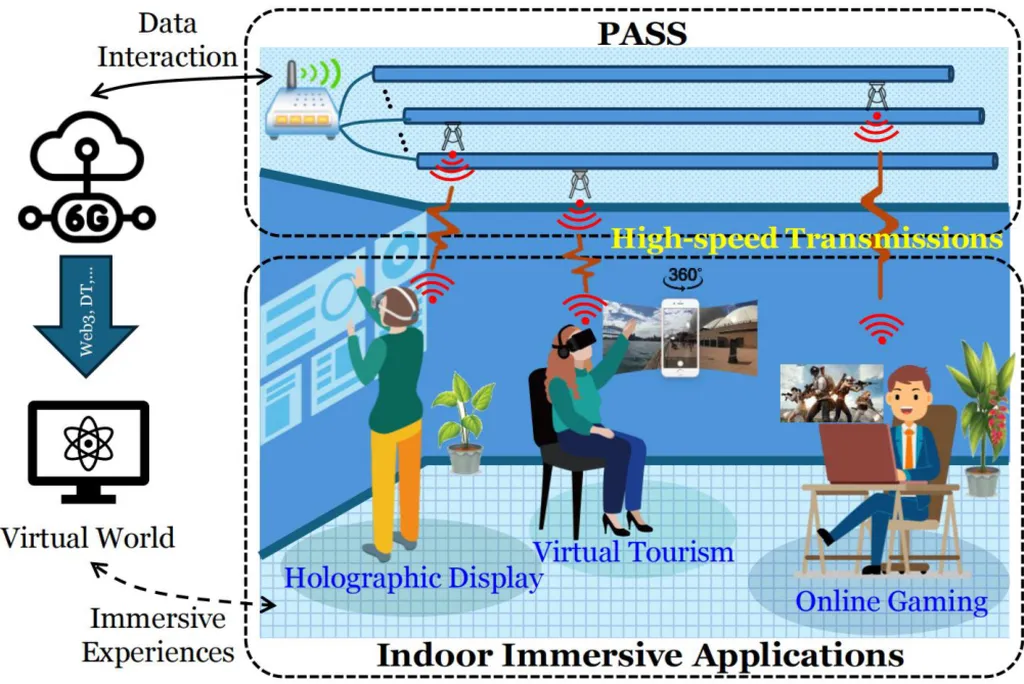
In the realm of indoor positioning systems, a groundbreaking study has emerged, spearheaded by a team of researchers including Yaoyu Zhang, Xin Sun, Jun Wang, Tianwei Hou, Anna Li, Yuanwei Liu, and Arumugam Nallanathan. Their work focuses on Pinching Antenna Systems (PASS), a novel approach that leverages flexible waveguides integrated with dielectric particles to reconstruct line-of-sight channels. This technology promises to revolutionize the way we navigate and interact within indoor environments.
The core of this research lies in the development of an uplink positioning system model specifically tailored for PASS. The team introduced a PASS-based Received Signal Strength Indication (RSSI) method, which efficiently measures the distance from users to each pinching antenna (PA). This method is not only efficient but also particularly well-suited for the unique characteristics of PASS. To further enhance accuracy, the researchers designed a PASS-based Weighted Least Squares (WLS) algorithm. This algorithm calculates the two-dimensional coordinates of users, providing a robust framework for precise indoor positioning.
The findings from this study are both insightful and practical. Firstly, the researchers observed that increasing the number of PAs on the waveguide significantly improves positioning accuracy and robustness. However, they also noted that beyond a certain threshold, the performance gains become marginal. This suggests an optimal point where additional PAs do not substantially enhance the system’s effectiveness. Another critical observation is that user locations between and near PAs yield superior positioning accuracy. This insight could guide the strategic placement of PAs to maximize the system’s performance.
The implications of this research are far-reaching. For instance, in the context of music and audio production, precise indoor positioning can enhance the spatial audio experience. Imagine a concert hall where the sound system dynamically adjusts based on the precise location of each listener, creating a personalized audio experience. Similarly, in recording studios, accurate positioning can improve the placement of microphones and instruments, optimizing the recording process. The potential applications extend to smart homes, where indoor positioning can enable more intuitive and responsive environments, tailored to the users’ movements and preferences.
Moreover, the robustness and accuracy of PASS can be particularly beneficial in large, complex indoor spaces such as museums, airports, and shopping malls. Visitors could receive location-based information and directions, enhancing their overall experience. In healthcare settings, precise indoor positioning can improve patient monitoring and care, ensuring that medical staff can quickly and accurately locate patients and equipment.
In conclusion, the research on PASS-based indoor positioning represents a significant advancement in the field of wireless technology. The insights and innovations presented by Yaoyu Zhang and his team open up new possibilities for enhancing the precision and reliability of indoor navigation systems. As we continue to explore and develop these technologies, we can look forward to a future where indoor spaces are more connected, intuitive, and responsive to our needs.