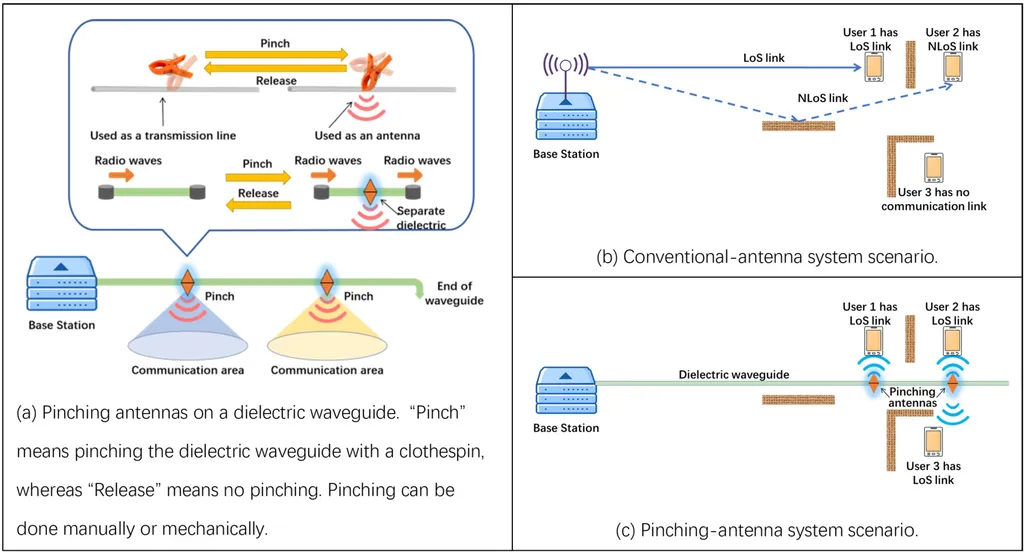
In the ever-evolving landscape of wireless communication, researchers are constantly seeking innovative solutions to enhance spectral efficiency and facilitate seamless coexistence of multiple networks. A recent study by Zeyang Sun, Xidong Mu, Shuai Han, Sai Xu, and Michail Matthaiou delves into the potential of pinching-antenna (PA)-enabled cognitive radio networks, offering a promising approach to simultaneous spectrum sharing.
The research focuses on a cognitive radio network where both the primary transmitter (PT) and secondary transmitter (ST) are equipped with a single waveguide and multiple PAs. This setup aims to optimize spectrum utilization by allowing primary and secondary networks to operate concurrently without significant interference. The study is grounded in a general Ricean fading channel model, which provides a realistic representation of the wireless environment.
One of the key contributions of this research is the derivation of a closed-form analytical expression for the average spectral efficiency (SE) achieved by PAs. This expression serves as the foundation for formulating a sum-SE maximization problem, which seeks to jointly optimize the primary and secondary pinching beamforming. The optimization process is subject to several constraints, including transmission power budgets, minimum antenna separation requirements, and feasible PA deployment regions.
To tackle this non-convex optimization problem, the researchers developed a three-stage optimization algorithm. The first stage involves determining the coarse positions of the PAs at the waveguide level. This is followed by wavelength-level refinements, which ensure constructive signal combination at the intended user and destructive superposition at the unintended user. The final stage focuses on ST power control, for which a closed-form solution is derived.
Simulation results presented in the study highlight several significant findings. Firstly, PAs demonstrate substantial improvements in spectral efficiency compared to conventional fixed-position antennas. Secondly, the proposed pinching beamforming design effectively suppresses interference and delivers superior performance for both even and odd numbers of PAs. Lastly, the three-stage optimization algorithm enables nearly orthogonal transmission between the primary and secondary networks, ensuring minimal interference and optimal spectrum utilization.
The implications of this research are profound for the future of wireless communication. By leveraging PA-enabled cognitive radio networks, it may be possible to achieve higher spectral efficiency and more efficient spectrum sharing, ultimately leading to improved performance and user experience in crowded wireless environments. As the demand for wireless services continues to grow, such innovations will be crucial in meeting the evolving needs of users and networks alike.