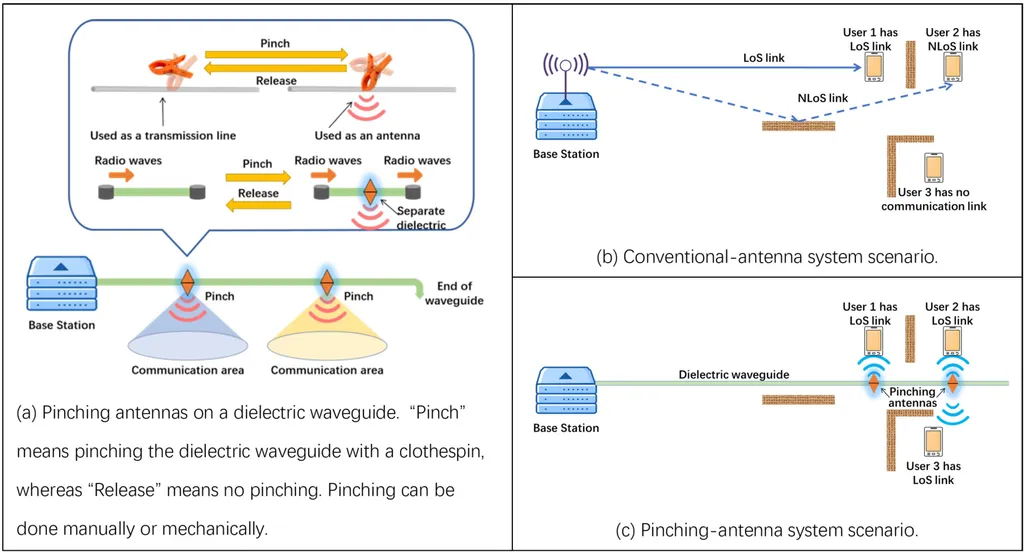
In the ever-evolving landscape of wireless communication and localization technologies, a groundbreaking study has emerged that promises to revolutionize the way we pinpoint locations using signal strength measurements. The research, led by Jiajun He, Xidong Mu, Hien Quoc Ngo, and Michail Matthaiou, introduces a novel localization framework underpinned by a pinching-antenna (PA) system. This innovative approach leverages received signal strength (RSS) measurements from downlink signals transmitted by the PAs to estimate the target location, offering a fresh perspective on the age-old challenge of accurate localization.
The study employs stochastic geometry to model the spatial distribution of the PAs, providing a robust analytical framework that enables tractable and insightful network-level performance analysis. This method allows researchers to derive closed-form expressions for target localizability and the Cramer-Rao lower bound (CRLB) distribution, which are crucial for evaluating the fundamental limits of PA-assisted localization systems. The significance of this breakthrough lies in its ability to offer practical guidance for selecting the optimal waveguide number to maximize localization performance, thereby eliminating the need for extensive simulations.
The numerical results presented in the study underscore the superiority of the PA-assisted approach over conventional fixed-antenna systems in terms of the CRLB. This finding is particularly noteworthy as it highlights the potential of the PA system to outperform existing technologies, paving the way for more accurate and efficient localization solutions. The implications of this research extend beyond theoretical advancements; they offer tangible benefits for real-world applications, from enhancing the precision of GPS systems to improving the functionality of wireless sensor networks.
As we delve deeper into the era of the Internet of Things (IoT) and smart technologies, the demand for reliable and precise localization systems continues to grow. The pinching-antenna system proposed by He, Mu, Ngo, and Matthaiou represents a significant step forward in meeting this demand. By providing a comprehensive analytical framework and demonstrating the superior performance of PA systems, this research not only advances our understanding of wireless localization but also sets the stage for future innovations in the field. The potential applications of this technology are vast, and its impact on various industries, from logistics to healthcare, could be profound. As we continue to explore the possibilities offered by this groundbreaking research, one thing is clear: the future of localization technology looks brighter than ever.