In the ever-evolving landscape of music technology, digital synthesis has been a cornerstone, driving innovation and shaping new genres and production styles. Traditional synthesis techniques have allowed us to mimic natural sounds and create entirely new artificial timbres, but the quest for novel methods of sound synthesis continues to push the boundaries of what’s possible. Enter Ashwin Pillay, whose recent research offers a fresh perspective on audio synthesis by redefining the Proportional-Integral-Derivative (PID) algorithm, a staple in feedback-based process control.
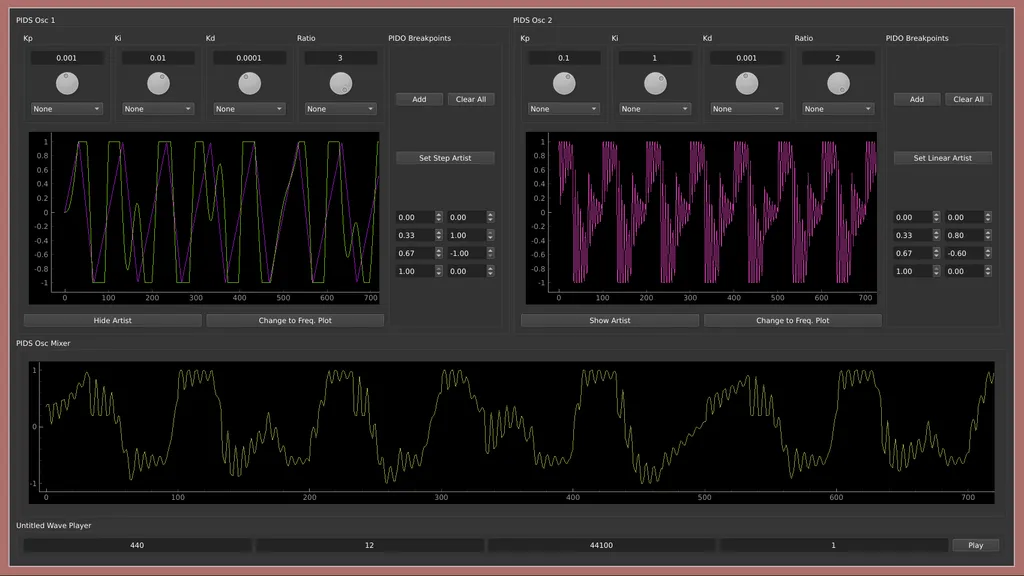
Pillay’s research introduces a novel synthesis framework that leverages the PID algorithm, typically used in industrial process control, to generate audio signals. This approach is not just an academic exercise; it has been implemented as a practical Python application, allowing for an in-depth study of the control parameters and their impact on the synthesized output. The PID algorithm, known for its robustness and simplicity, offers a unique lens through which to explore sound synthesis, potentially unlocking new sonic territories.
The study delves into the practical applications of this PID-based synthesis technique, examining its potential as both an audio signal and a Low-Frequency Oscillator (LFO) generator. One of the most intriguing aspects of Pillay’s research is its comparison with established synthesis methods like Frequency Modulation (FM) and Wavetable synthesis. The findings suggest that PID-based synthesis could offer a viable alternative, providing producers and sound designers with another tool in their arsenal to craft unique and complex sounds.
However, no research is without its limitations. Pillay’s study acknowledges certain imperfections in the current framework, highlighting areas that require further refinement. These imperfections present opportunities for future research, inviting other innovators to build upon this foundation and explore potential improvements. The research directions suggested include enhancing the algorithm’s stability, expanding its parameter range, and integrating it with other synthesis techniques to create hybrid models.
The implications of this research extend beyond the realm of music production. By drawing from industrial process control, Pillay’s work exemplifies the interdisciplinary nature of modern technological innovation. It underscores the potential for cross-pollination of ideas between seemingly disparate fields, leading to breakthroughs that might otherwise go unnoticed. For music producers, sound designers, and audio engineers, this research opens up new avenues for experimentation and creativity, pushing the envelope of what can be achieved in audio synthesis.
In conclusion, Ashwin Pillay’s exploration of PID-based audio synthesis represents a significant step forward in the field of digital music technology. By redefining an industrial algorithm for musical purposes, Pillay not only contributes to the ongoing evolution of sound synthesis but also demonstrates the value of looking beyond traditional boundaries for inspiration. As the music technology community continues to build on these findings, we can expect to see even more innovative applications and refinements, further enriching the sonic landscape.