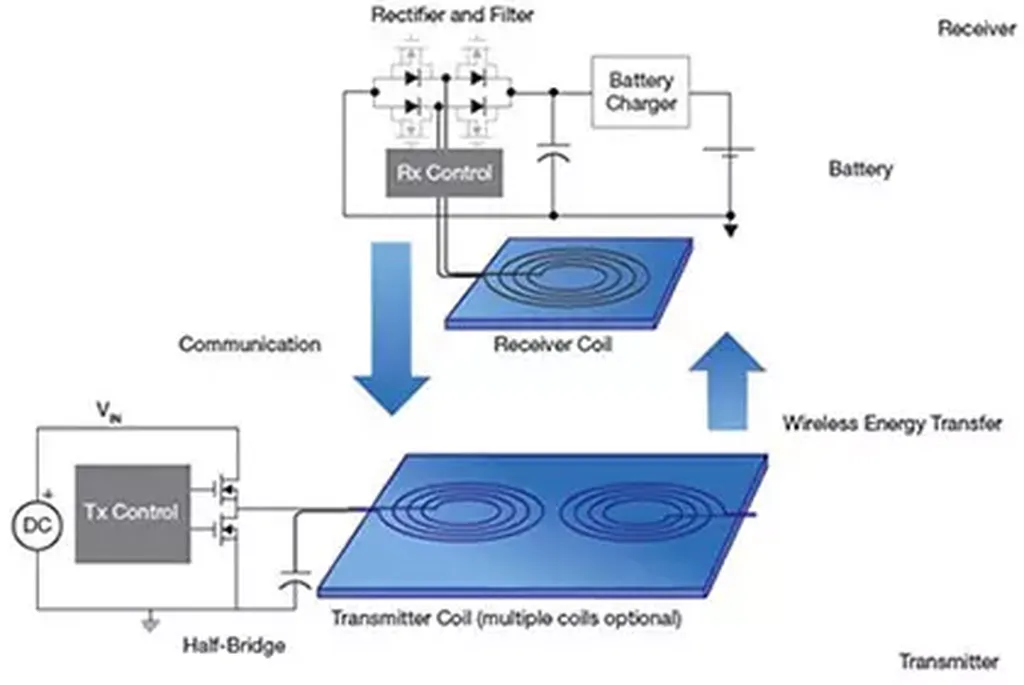
In a groundbreaking development, researchers have proposed a novel framework that promises to revolutionize wireless power transfer (WPT) by leveraging a pinching antenna system (PASS). This innovative approach allows energy harvesting receivers (EHRs) and information decoding receivers (IDRs) to coexist, enhancing both energy harvesting efficiency and communication quality. The research, conducted by Deqiao Gan, Xiaoxia Xu, Xiaohu Ge, Yue Liu, and Yuanwei Liu, introduces a bi-level optimization problem to tackle the strong coupling between optimization variables, a common challenge in WPT systems.
The upper level of the optimization problem focuses on jointly optimizing transmit beamforming, pinching antenna (PA) positions, and the feasible interval of power radiation ratios to maximize power conversion efficiency (PCE) while meeting rate requirements. Meanwhile, the lower level refines the power radiation ratio to maximize the sum rate. For the two-user scenario, where an EHR and an IDR coexist, the researchers developed alternating optimization (AO)-based and weighted minimum mean square error (WMMSE)-based algorithms. These algorithms achieve stationary solutions for transmit beamforming, PA positions, and power radiation ratios. For the multi-user case, a quadratic transform-Lagrangian dual transform (QT-LDT) algorithm was proposed to iteratively update PCE and sum rate by optimizing PA positions and power radiation ratios individually. Closed-form solutions were derived for both maximization problems, ensuring efficient and effective implementation.
Numerical simulations demonstrated the superiority of the proposed PASS-WPT framework over conventional MIMO and baseline PASS with fixed power radiation. The results showed significant improvements: the PASS-WPT framework achieved 81.45% and 43.19% enhancements in PCE of EHRs compared to conventional MIMO and baseline PASS, respectively. Additionally, it increased the sum rate by 77.81% and 31.91% for IDRs. These findings highlight the potential of the PASS-WPT framework to significantly outperform existing technologies, paving the way for more efficient and effective wireless power transfer solutions.
The implications of this research are far-reaching, particularly in the realm of music and audio production. As wireless technology continues to evolve, the need for reliable and efficient power transfer solutions becomes increasingly critical. The PASS-WPT framework could enable the development of wireless devices that require less frequent charging, enhancing the portability and convenience of audio equipment. This could be particularly beneficial for musicians and producers who rely on a variety of wireless devices during performances and recording sessions. Furthermore, the improved communication quality could lead to better audio transmission, reducing latency and ensuring high-fidelity sound reproduction. As the technology matures, we can expect to see its integration into a wide range of audio applications, ultimately transforming the way we create and experience music.