
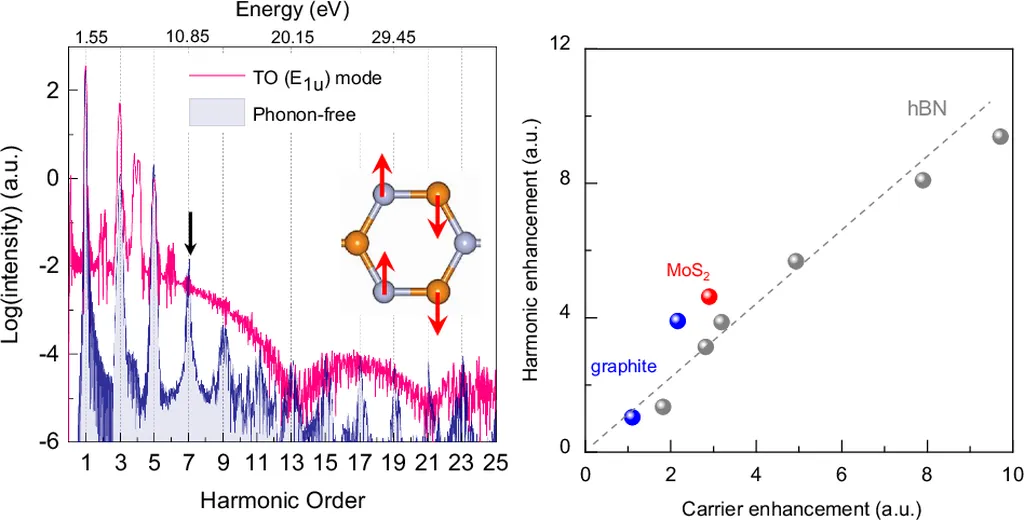
High harmonic generation (HHG) in solids has long been a fascinating area of study, but it’s often been shrouded in a bit of mystery. The interpretation of HHG spectra in solids typically relies on phenomenological dephasing times that are much shorter than what we’d expect from microscopic scattering processes. This discrepancy has led to some head-scratching in the scientific community. However, a recent study sheds some light on this puzzle.
The study, led by Aday Cárdenas, David N. Purschke, Graham G. Brown, Pablo San-Jose, Rui E. F. Silva, and Álvaro Jiménez-Galán, shows that zero-point fluctuations associated with optical phonons play a crucial role in this phenomenon. These fluctuations naturally suppress long-range electronic coherences and generate clean harmonic spectra, all without introducing ad-hoc decoherence parameters.
The researchers used a 1D semiconductor composed of two distinct sites per unit cell and realistic phonon amplitudes. They demonstrated that random per-site optical-phonon jitter reproduces the spectral sharpening typically attributed to ultrafast T2 dephasing. This is a significant finding because it identifies a natural mechanism that explains the observed HHG spectra in solids.
In contrast, the study found that acoustic phonons and local strain, whose distortions are correlated over nanometer scales, produce negligible spectral cleaning. This suggests that the type of phonon involved is crucial in the HHG process.
The researchers also showed that long-range site coherence leads to carrier-envelope-phase-dependent effects in the HHG spectrum driven by long pulses. However, these effects collapse once optical-phonon-induced decoherence is included. This further underscores the importance of optical phonons in the HHG process.
The implications of this research are far-reaching. It identifies optical zero-point motion as a key mechanism governing coherence in solid-state HHG. It also demonstrates that this can be qualitatively modeled in periodic solids through site-distance-dependent dephasing. Furthermore, the study suggests that carrier-envelope-phase-resolved measurements can probe electronic coherence lengths and atomic fluctuations in crystalline materials.
This research is a significant step forward in our understanding of HHG in solids. It provides a natural explanation for the observed phenomena and opens up new avenues for exploring the fascinating world of solid-state HHG.