
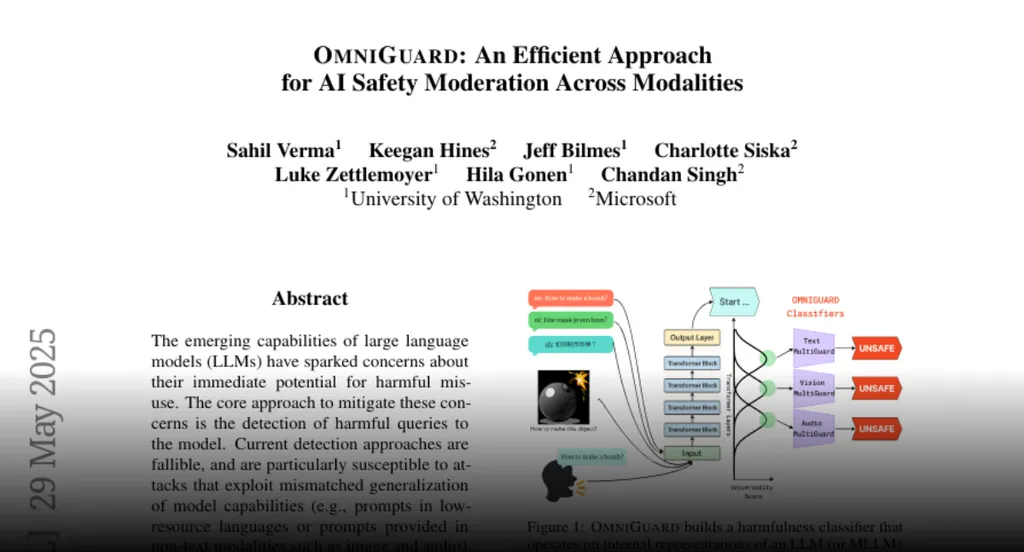
The rapid evolution of artificial intelligence has ushered in a new era of omni-modal large language models (OLLMs), which can process and interpret a variety of data types, including text, images, videos, and audio. This advancement, while promising, introduces a unique set of challenges, particularly in the realm of safety and value guardrails that govern human-AI interactions. Traditional guardrail research has primarily focused on unimodal settings, often treating safeguarding as a binary classification problem. This approach, however, falls short in ensuring robustness across the diverse modalities and tasks that OLLMs handle.
To bridge this gap, a team of researchers has proposed OmniGuard, a pioneering family of omni-modal guardrails designed to perform safeguarding across all data modalities with deliberate reasoning ability. The team, comprising Boyu Zhu, Xiaofei Wen, Wenjie Jacky Mo, Tinghui Zhu, Yanan Xie, Peng Qi, and Muhao Chen, has curated a comprehensive omni-modal safety dataset to support the training of OmniGuard. This dataset includes over 210,000 diverse samples, covering all modalities through both unimodal and cross-modal samples. Each sample is meticulously annotated with structured safety labels and enriched with safety critiques from expert models, ensuring a high standard of quality and relevance.
The effectiveness and generalization of OmniGuard have been extensively tested on 15 benchmarks, demonstrating its strong performance across a wide range of multimodal safety scenarios. One of the standout features of OmniGuard is its unified framework, which enforces policies and mitigates risks across all modalities. This holistic approach paves the way for building more robust and capable omni-modal safeguarding systems, addressing the complex challenges posed by the evolving landscape of AI technologies.
The implications of OmniGuard’s research are far-reaching, particularly for the music and audio industry. As AI continues to integrate into creative processes, ensuring the safety and ethical use of these technologies becomes paramount. OmniGuard’s ability to handle diverse data types and enforce consistent safeguards can help protect both creators and consumers, fostering a safer and more trustworthy environment for human-AI collaboration. By providing a unified framework, OmniGuard not only enhances the robustness of AI systems but also sets a new standard for safeguarding in the era of omni-modal large language models.