
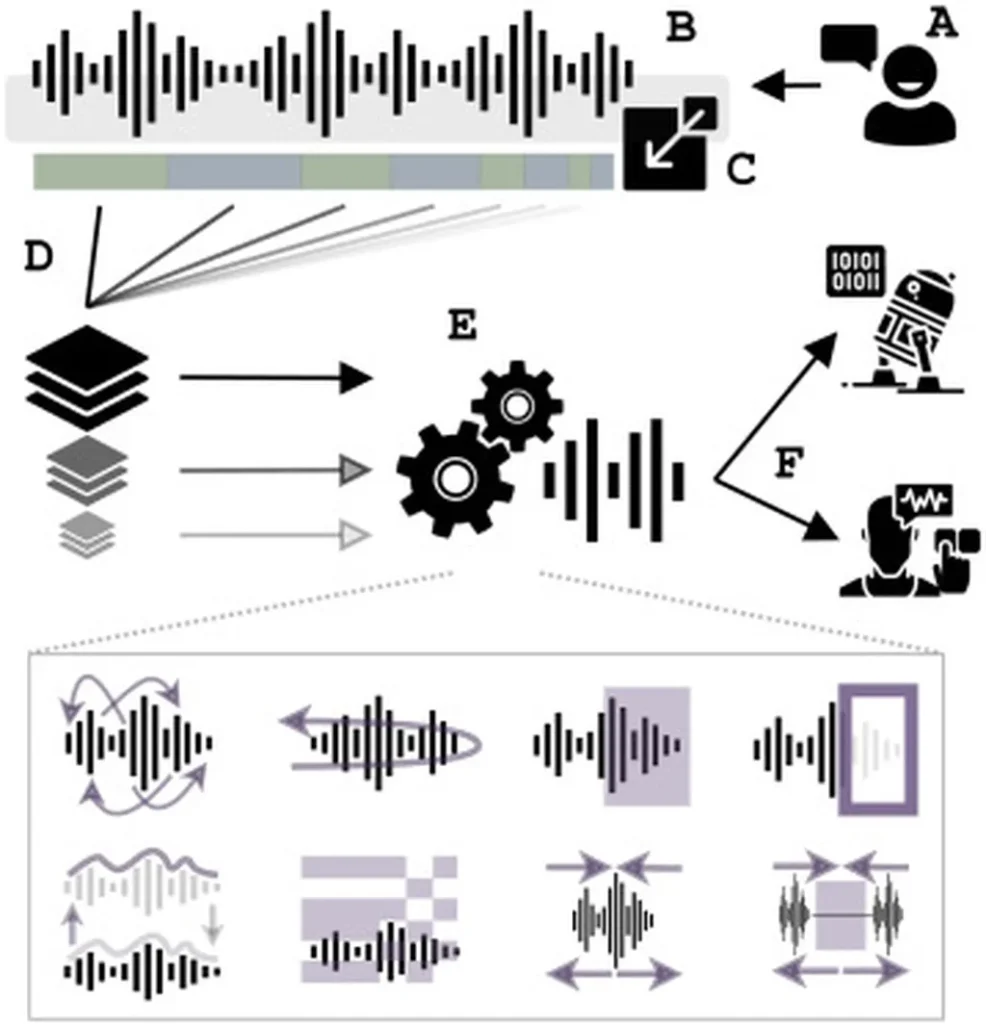
Nao Tokui and Tom Baker have introduced a groundbreaking technique in the world of audio resynthesis, one that promises to revolutionize how we manipulate and create sound. Their method, called Latent Granular Resynthesis, is a fresh twist on the classic granular synthesis concept, but with a modern, neural network-driven approach.
Traditional granular synthesis involves chopping up audio into tiny segments, or “grains,” and then rearranging them to create new sounds. Tokui and Baker’s technique takes this idea into the realm of latent vectors, which are compact, encoded representations of audio data. By encoding a source audio corpus into latent vector segments, they create a “granular codebook.” This codebook serves as a reference for transforming a target audio signal. Each latent grain of the target signal is matched to its closest counterpart in the codebook, resulting in a hybrid sequence that is then decoded back into audio.
The beauty of this method lies in its ability to preserve the temporal structure of the target audio while adopting the timbral characteristics of the source. This means that the rhythmic and structural elements of the original sound remain intact, but the tonal qualities are transformed to match the source material. Importantly, this technique doesn’t require any model training, making it accessible and versatile for a wide range of audio materials.
One of the standout features of Latent Granular Resynthesis is its ability to naturally avoid the discontinuities that are common in traditional concatenative synthesis. This is achieved through the codec’s implicit interpolation during the decoding process, ensuring smoother and more coherent audio output.
For those eager to dive in and experiment, Tokui and Baker have provided supplementary material and a proof-of-concept implementation. You can explore the code and try it out with your own sounds at the provided GitHub and Hugging Face links. This open approach not only fosters creativity but also invites the broader community to contribute to and build upon this innovative technique.
The implications of this research are vast. For producers and sound designers, it opens up new avenues for creative exploration, allowing for the seamless blending of different timbres and textures. For developers, it offers a powerful tool that can be integrated into various audio processing workflows. And for enthusiasts, it’s an exciting opportunity to experiment with cutting-edge audio technology.
In essence, Latent Granular Resynthesis represents a significant step forward in audio technology. By leveraging the power of neural audio codecs and latent vector representations, Tokui and Baker have created a technique that is both innovative and practical. It’s a testament to how traditional concepts can be reimagined with modern tools to push the boundaries of what’s possible in sound design and audio production.