In the realm of audio technology, the quest for achieving precise directional sound capture has always been a significant challenge, especially when dealing with compact microphone arrays. Traditional beamforming techniques, which are designed to focus on sound from a particular direction while minimizing other sounds, often fall short when the array of microphones is compact. The effectiveness of these methods typically degrades, leading to less than optimal sound capture.
A groundbreaking approach known as Neural Directional Filtering (NDF) has been developed to address these limitations. This innovative method leverages the power of deep neural networks to enable sound capture with a predefined directivity pattern. The NDF works by computing a single-channel complex mask from the signals received by the microphone array. This mask is then applied to a reference microphone, effectively producing an output that mimics a virtual directional microphone with the desired directivity pattern.
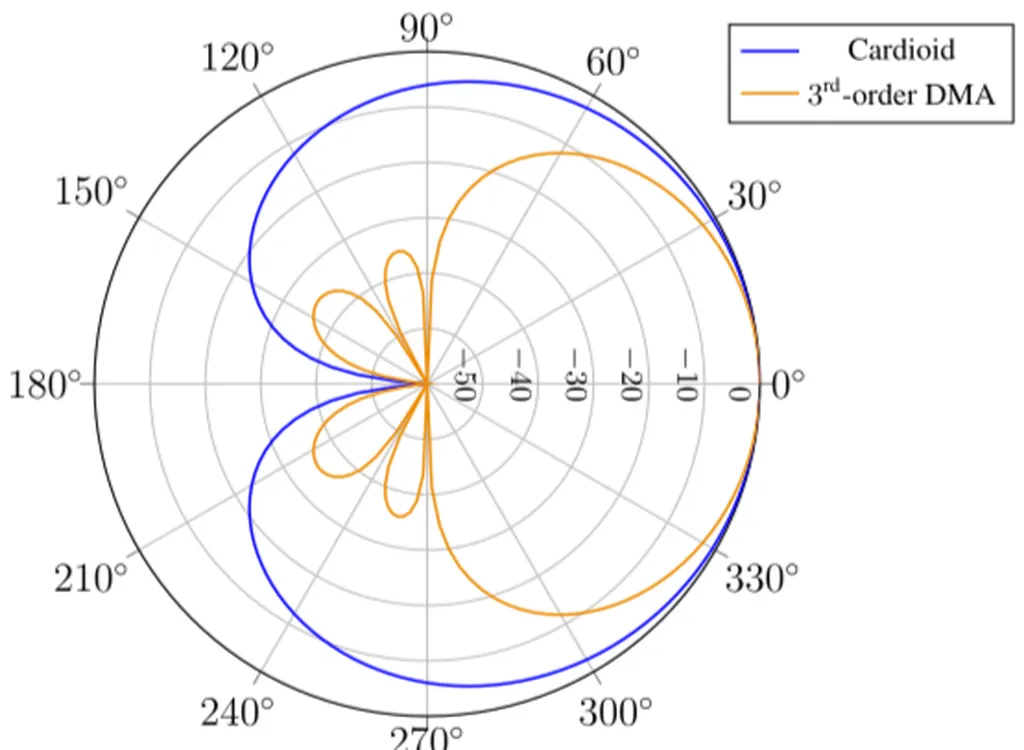
The researchers behind this approach, Weilong Huang, Srikanth Raj Chetupalli, Mhd Modar Halimeh, Oliver Thiergart, and Emanuël Habets, have introduced several training strategies to optimize the NDF. They have also proposed data-dependent metrics to evaluate the directivity pattern and directivity factor. The results of their work are impressive. The NDF achieves a frequency-invariant directivity pattern, even above the spatial aliasing frequency, which is a significant improvement over traditional methods. Moreover, it can approximate diverse and higher-order patterns and steer the pattern in different directions. Perhaps most notably, the NDF generalizes well to unseen conditions, making it a versatile tool for various audio applications.
Experimental comparisons have demonstrated that the NDF outperforms conventional beamforming and parametric approaches. This superior performance suggests that NDF could revolutionize the way we capture and process sound, particularly in scenarios where compact microphone arrays are used. The potential applications of this technology are vast, ranging from consumer electronics and telecommunications to advanced audio systems in vehicles and smart home devices. As the field of audio technology continues to evolve, the NDF approach offers a promising path forward, enabling more precise and flexible sound capture in a wide range of environments.