NASA’s Polarimeter to Unify the Corona and Heliosphere (PUNCH) mission is set to revolutionize our understanding of the solar corona and heliosphere. This ambitious endeavor, launched in March 2025 and beginning science operations in June 2025, aims to unravel the intricate processes that connect these two critical regions of our solar system. The mission’s primary objectives are to comprehend how coronal structures evolve into the ambient solar wind and to track the dynamic evolution of transient structures, such as coronal mass ejections, in the young solar wind.
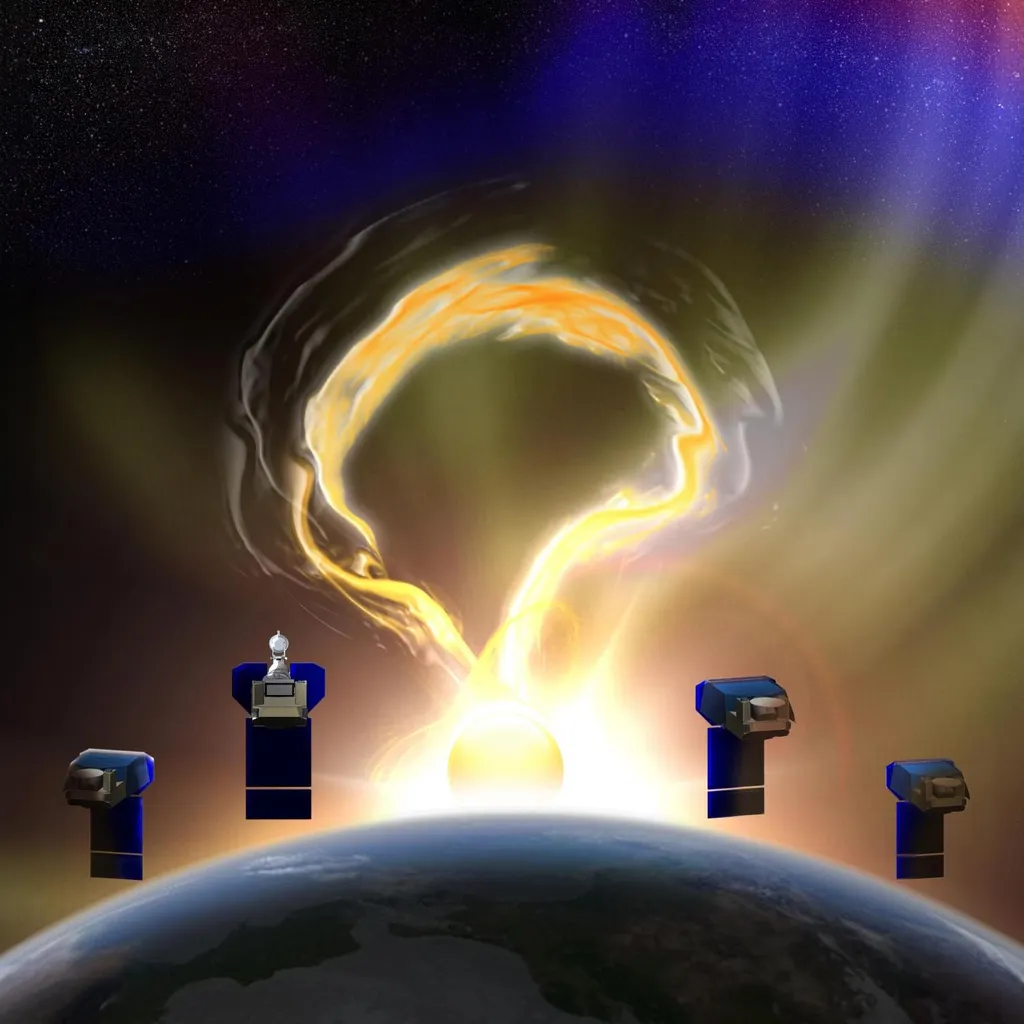
To achieve these goals, PUNCH employs a constellation of four small spacecraft in Sun-synchronous low Earth orbit. Each spacecraft is equipped with a visible-light imager, arranged in a 1+3 configuration. This setup includes a single Narrow Field Imager solar coronagraph, which captures images of the outer corona at various position angles and solar elongations ranging from 1.5 degrees (6 solar radii) to 8 degrees (32 solar radii). Additionally, three separate Wide Field Imager heliospheric imagers collectively capture views of the entire inner solar system, covering solar elongations from 3 degrees (12 solar radii) to 45 degrees (180 solar radii) from the Sun.
One of the standout features of PUNCH is its ability to collect linearly polarized images, which allows researchers to infer the three-dimensional structure of visible features without the need for stereoscopy. The instruments on board the spacecraft are meticulously matched in wavelength passband, support overlapping instantaneous fields of view, and are operated synchronously. This coordination enables them to function as a single “virtual instrument” with a 90-degree wide field of view, centered on the Sun.
The PUNCH mission is a collaborative effort involving a diverse team of researchers and organizations. Key figures include Craig DeForest, Sarah Gibson, Ronnie Killough, Nick Waltham, Matt Beasley, Robin Colaninno, Glenn Laurent, Daniel Seaton, Marcus Hughes, Madhulika Guhathakurta, Nicholeen Viall, Raphael Attie, Dipankar Banerjee, Luke Barnar, Doug Biesecker, Mario Bisi, Volker Bothmer, Antonina Brody, Joan Burkepile, Iver Cairns, Jennifer Campbell, David Cheney, Traci Case, Amir Caspi, Rohit Chhiber, Matthew Clapp, Steven Cranmer, Jackie Davies, Curt de Koning, Mihir Desai, Heather Elliott, Samaiyah Farid, Bea Gallardo-Lacourt, Chris Gilly, Caden Gobat, Mary Hanson, Richard Harrison, Donald Hassler, Chase Henley, Alan Henry, Russell Howard, Bernard Jackson, Samuel Jones, Don Kolinski, Derek Lamb, Florine Lehtinen, Chris Lowder, Anna Malanushenko, William Matthaeus, David McComas, Jacob McGee, Huw Morgan, Divya Oberoi, Dusan Odstrcil, Chris Parmenter, Ritesh Patel, Francesco Pecora, Steve Persyn, Victor Pizzo, Simon Plunkett, Elena Provornikova, Nour Eddine Raouafi, Jillian Redfern, Alexis Rouillard, Kelly Smith, Keith Smith, Zachary Talpas, James Tappin, Arnaud Thernisien, Barbara Thompson, Samuel Van Kooten, Kevin Walsh, David Webb, William Wells, Matthew West, Zachary Wiens, and Yan Yang.
PUNCH’s open data policy ensures that all collected data is freely available without any proprietary period, fostering a collaborative and inclusive research environment. Furthermore, PUNCH Science Team Meetings are open to all, encouraging broad participation and the exchange of ideas. This mission promises to provide unprecedented insights into the solar corona and heliosphere, potentially reshaping our understanding of solar dynamics and their impact on space weather. As we await the mission’s findings, the scientific community is poised for a new era of discovery and innovation.