
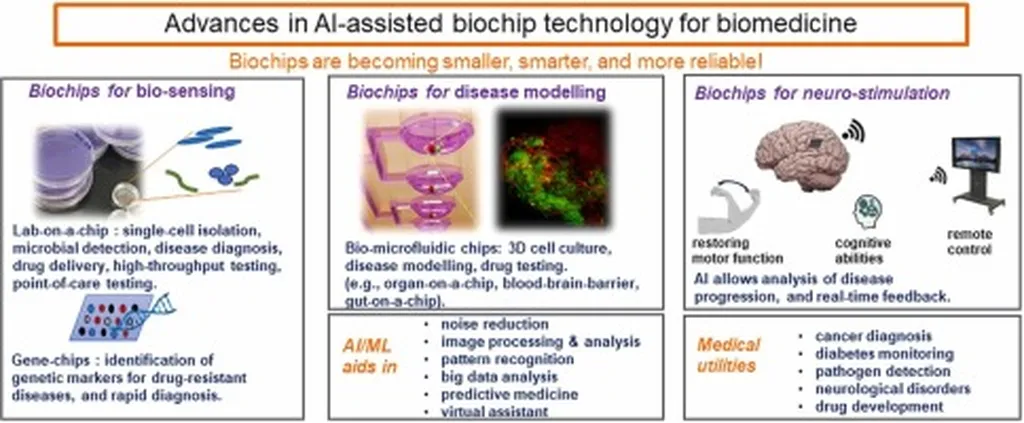
In the rapidly evolving landscape of mobile genomics, a groundbreaking development has emerged that could redefine the boundaries of genetic analysis. Researchers Sebastian Magierowski, Zhongpan Wu, Abel Beyene, and Karim Hammad have unveiled a revolutionary CMOS system-on-chip (SoC) designed specifically for mobile genetic analysis. This innovation is poised to bring the power of genomics directly to the edge, enabling real-time, on-device genome analysis with unprecedented efficiency.
The impetus behind this research stems from the growing success of miniature DNA sequencing hardware in mobile contexts. As these devices become more prevalent, the demand for efficient machine learning at the edge has surged. The domain of mobile genomics leverages deep learning techniques, which are already familiar from applications in speech and time-series analysis, to handle both low-level signal processing and high-level genomic interpretation. However, nanopore sequencing, a method used in these devices, presents a unique challenge: raw data rates that are over 100 times higher than those encountered in audio processing. This necessitates more aggressive compute and memory management strategies.
The researchers’ solution combines a multi-core RISC-V processor with tightly coupled accelerators tailored for deep learning and bioinformatics. This heterogeneous compute fabric is designed to handle the immense data rates and complex computations required for real-time genomic analysis. The key to achieving energy-efficient operation lies in a hardware/software co-design strategy. By integrating deep learning, edge computing, and domain-specific hardware, the researchers have created a system that exemplifies the potential of next-generation mobile genomics.
The implications of this research are profound. The ability to perform real-time, on-device genome analysis opens up new possibilities for personalized medicine, field research, and public health. For instance, medical professionals could use portable sequencing devices to provide immediate diagnoses and treatment plans based on a patient’s genetic profile. Similarly, researchers in remote locations could conduct genetic studies without the need for expensive and time-consuming data transfer to centralized laboratories.
Moreover, the integration of deep learning and edge computing in this SoC design highlights the broader trend of bringing advanced computational capabilities to the edge of the network. This shift not only reduces latency and bandwidth requirements but also enhances privacy and security by keeping sensitive genetic data on the device rather than transmitting it to the cloud.
In conclusion, the development of this CMOS system-on-chip represents a significant leap forward in the field of mobile genomics. By combining cutting-edge deep learning techniques with efficient hardware design, the researchers have created a powerful tool that could transform genetic analysis and bring the benefits of genomics to a wider range of applications. As this technology continues to evolve, it is likely to play a pivotal role in shaping the future of personalized medicine and genetic research.