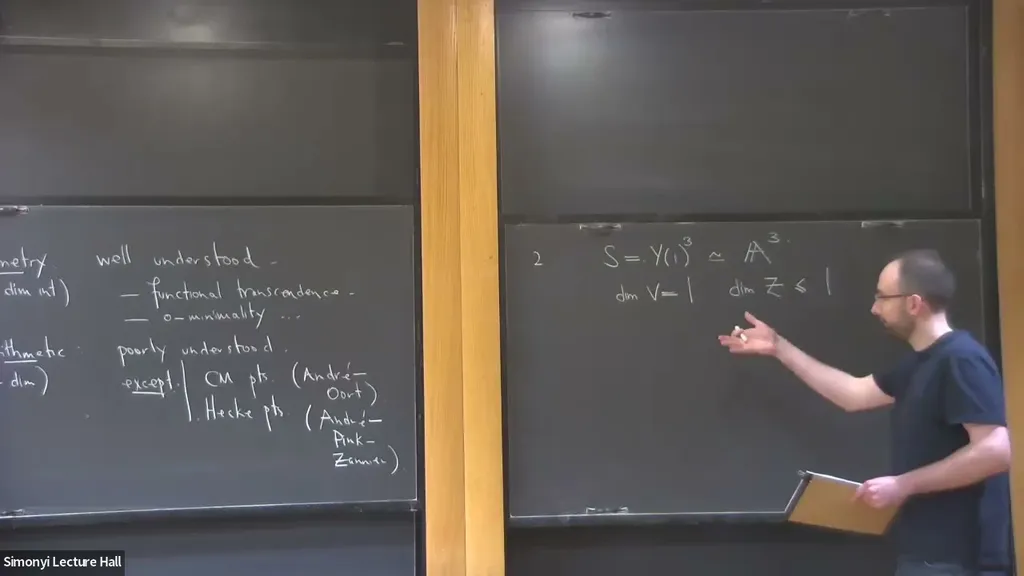
In the realm of mathematical research, particularly within the field of algebraic geometry, a significant breakthrough has been achieved by Bijay Raj Bhatta. The focus of this research is the Zilber-Pink conjecture, a prominent unsolved problem that has captivated mathematicians for years. Bhatta’s work specifically addresses the intersection of an irreducible Hodge generic algebraic subvariety \( V \) within the moduli space of abelian varieties \( \mathcal{A}_g \) with special subvarieties of all simple PEL types, excluding the type \(\mathbb{Z}\).
The Zilber-Pink conjecture posits that the intersection of certain algebraic subvarieties with special subvarieties is “unlikely” unless it satisfies specific conditions. Bhatta’s research provides a proof for this conjecture under the assumption of the Large Galois Orbits conjecture, which is a related but distinct mathematical hypothesis. This proof is a substantial step forward, as it not only confirms the conjecture for the specified types but also establishes parameter height bounds for the arithmetic components involved in the Pila-Zannier strategy. This strategy is a powerful tool used in the study of unlikely intersections and diophantine geometry.
The research is particularly notable for its focus on Albert types III and IV, which are complex and less understood compared to other types. By providing parameter height bounds, Bhatta’s work offers a clearer understanding of the arithmetic structures underlying these types. This clarity is crucial for further advancements in the field, as it allows researchers to better navigate the intricate landscape of algebraic varieties and their intersections.
Bhatta’s paper is a sequel to the work of Daw and Orr, titled “Lattices with skew-Hermitian forms over division algebras and unlikely intersections,” published in 2023. The previous work laid the groundwork for understanding the interplay between lattices and algebraic varieties, and Bhatta’s research builds upon this foundation. By doing so, it bridges the gap between theoretical conjectures and practical arithmetic bounds, making the abstract more tangible and applicable.
The implications of Bhatta’s findings are far-reaching. For mathematicians, this research provides a robust framework for exploring the Zilber-Pink conjecture and related problems. For the broader scientific community, it highlights the importance of interdisciplinary approaches in solving complex mathematical problems. The establishment of parameter height bounds not only validates existing theories but also opens new avenues for research in algebraic geometry and number theory.
In summary, Bijay Raj Bhatta’s work represents a significant milestone in the study of the Zilber-Pink conjecture. By proving the conjecture under specific conditions and establishing parameter height bounds for Albert types III and IV, Bhatta has contributed a pivotal piece to the puzzle of unlikely intersections. This research not only advances our understanding of algebraic varieties but also underscores the collaborative nature of mathematical discovery, building upon the work of predecessors to push the boundaries of what is known and what is possible.