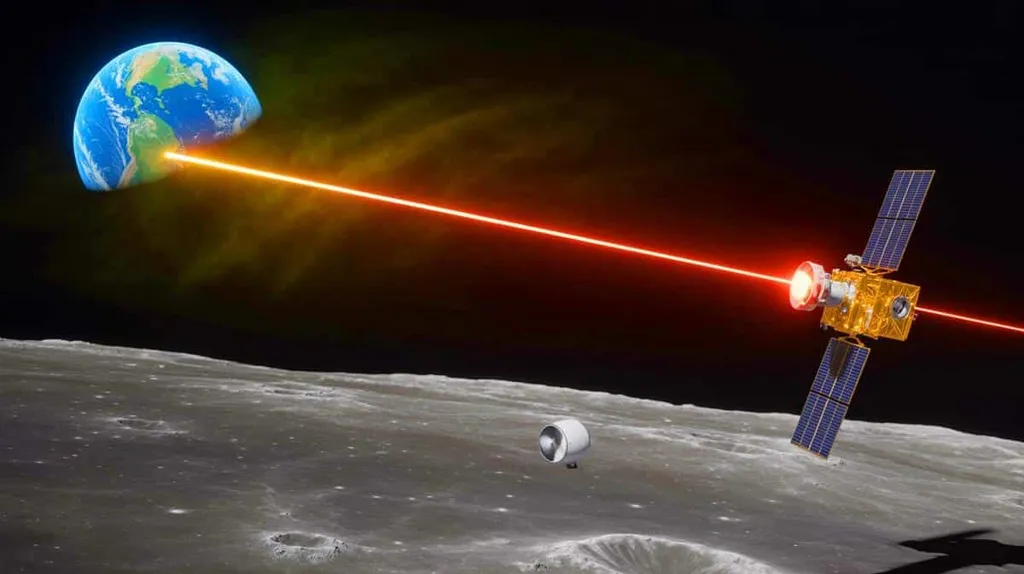
In a groundbreaking development for lunar exploration, an international team of researchers has defined and realized the International Lunar Reference Frame (ILRF), a crucial system for future lunar missions. This reference frame is essential for ensuring consistency in positioning, navigation, cartography, and timing on the Moon. The Lunar Reference System (LRS) is defined with its origin at the lunar center of mass, known as the lunocenter, and is oriented and scaled to provide a stable reference for all lunar activities.
The ILRF is realized as the Principal Axis (PA) system, which is attached to the Moon’s surface and co-rotates with it. The realization of the ILRF is based on the variance component estimation of three lunar ephemeris solutions: INPOP21a, DE430, and EPM2021. These solutions provide the position of the lunar center of mass and the rotation Euler angles, including precession, nutation, and proper rotation. The researchers have provided numerical solutions that are valid from the period covered by Lunar Laser Ranging (LLR) data in 1970 to extrapolated ILRF realizations in 2052, ensuring its utility for both current and future lunar missions.
The combined ILRF is characterized by a mean error of 17.6 cm for the period between 2010 and 2030. Of this error, 15.3 cm is attributed to the origin, and 8.6 cm to the orientation realization. The error in the realization of the origin is primarily due to the poor geometry of the retroreflector network, which results in a high correlation between the scale and the X component of the lunocenter in the PA system. Despite this, the LLR post-fit residuals in the ILRF are impressively low, at the level of 2-3 cm in terms of the standard deviations of one-way ranges for the best-performing LLR stations.
The transformation between the ILRF and other reference frame realizations in the PA system has a mean error of about 3 cm. The mean transformation error to the DE421 Mean Earth frame is slightly higher, at 5 cm. This research, conducted by Krzysztof Sośnica, Agnès Fienga, Dmitry Pavlov, Nicolas Rambaux, and Radosław Zajdel, represents a significant advancement in the precision and reliability of lunar reference systems, paving the way for more accurate and consistent lunar exploration and research.