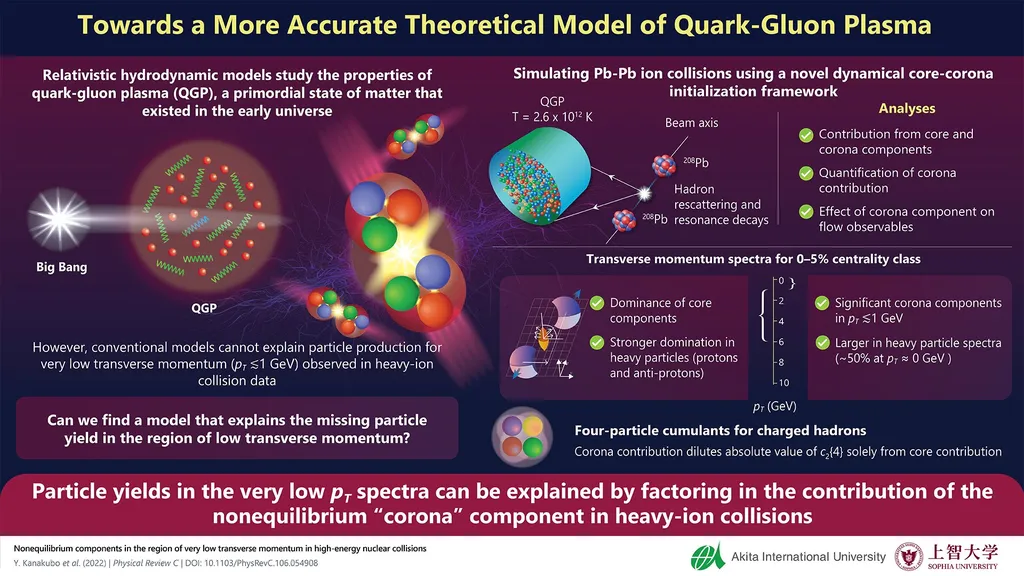
A decade ago, the field of heavy ion collisions was marked by a significant discovery: the identification of a strongly-coupled Quark-Gluon-Plasma (sQGP). This plasma exhibited properties of a near-perfect liquid with remarkably low viscosity. Since then, the Large Hadron Collider (LHC) program has greatly expanded our understanding of this phenomenon. Now, it’s time to consolidate our knowledge and outline the next set of questions to explore.
One of the fascinating developments in this field is the study of hydrodynamical perturbations, which manifest as higher harmonics of angular correlations. These perturbations are essentially long-lived sound waves within the plasma. Recent research has delved into various reactions involving these sound waves. For instance, phonons—the quantum mechanical vibrations in the crystal lattice—can decay into two particles, a process known as “loop viscosity.” Another intriguing reaction is the interaction of phonons with a magnetic field, resulting in the emission of photons or dileptons, a phenomenon termed “sono-magneto-luminescence.” Additionally, the interaction of two phonons can produce a gravity wave, providing a unique probe into the conditions of the Big Bang.
The mainstream issues in the field now revolve around understanding the transition between different types of collisions: proton-proton (pp), proton-nucleus (pA), and heavy ion (AA) collisions. A key goal is to identify the “smallest drops” of sQGP that exhibit collective or hydrodynamic behavior. This quest is crucial for understanding the fundamental properties of the sQGP and its behavior under various conditions.
Another hotly debated topic is the out-of-equilibrium stage of the collisions and the mechanisms of equilibration. Researchers are particularly interested in understanding these processes in both weak and strong coupling regimes. The equilibration process is critical for forming the sQGP and understanding how it reaches its near-perfect liquid state.
Edward Shuryak, a prominent researcher in this field, has been at the forefront of these discussions. His work has contributed significantly to our understanding of the sQGP and the complex dynamics involved in heavy ion collisions. As the field continues to evolve, the insights gained from these studies will not only deepen our knowledge of the fundamental forces and particles but also pave the way for new technological and scientific advancements.