In a significant stride towards enhancing audio experiences in reverberant spaces, researchers have introduced the ISOBEL Sound Field dataset, a novel collection of measurements from real rooms that promises to bridge the gap between synthetic and real-world sound fields. This breakthrough, coupled with an advanced deep learning-based method, opens new avenues for accurate sound field reconstruction using a minimal number of microphones, with practical applications ranging from personalized audio experiences to advanced audio production techniques.
The ISOBEL Sound Field dataset, developed by Miklas Strøm Kristoffersen, Martin Bo Møller, Pablo Martínez-Nuevo, and Jan Østergaard, provides a comprehensive set of measurements from four real rooms. This dataset is designed to facilitate the evaluation of sound field reconstruction methods at low frequencies, addressing the challenges posed by reverberant environments. Traditional methods of acquiring sound fields involve labor-intensive measurements of impulse response functions throughout the room. In contrast, the ISOBEL dataset offers a more efficient approach by enabling reconstruction methods that require significantly fewer measurements, thereby saving time and resources.
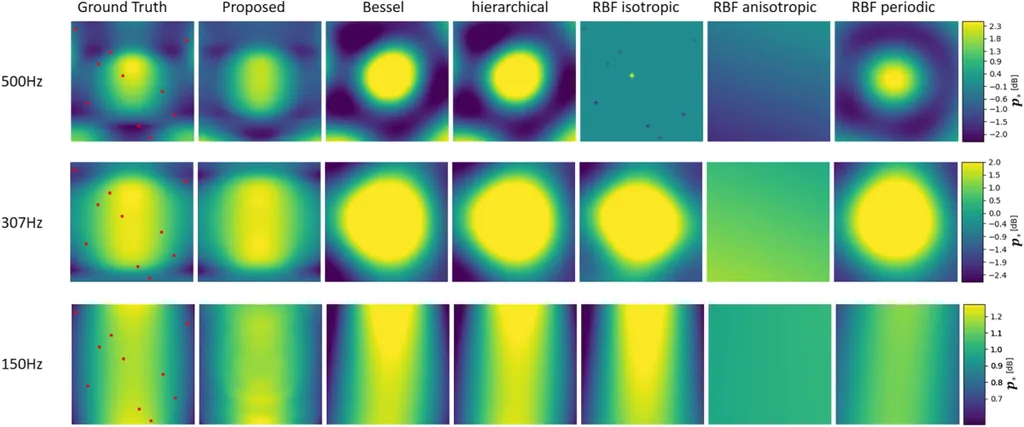
The researchers have also advanced a recent deep learning-based method for sound field reconstruction, which utilizes a very low number of microphones. This method employs a U-Net-like neural network architecture to model both the magnitude and phase response of the sound field. The complex-valued sound field reconstruction achieved through this approach demonstrates high accuracy, allowing for the creation of personalized sound zones with contrast ratios comparable to ideal room transfer functions. This is particularly noteworthy as it achieves such results using only 15 microphones below 150 Hz, a substantial improvement over traditional methods.
The practical applications of this research are vast and promising. In the realm of audio production, accurate sound field reconstruction can enhance the mixing and mastering processes, enabling engineers to better understand and manipulate the acoustic environment in which recordings are made. This can lead to more precise and nuanced audio productions, tailored to specific listening environments. Additionally, the ability to create personalized sound zones can revolutionize home audio systems, concert hall designs, and even virtual reality experiences, providing listeners with an immersive and tailored audio experience.
Furthermore, the ISOBEL Sound Field dataset and the advanced deep learning method offer valuable tools for researchers and developers in the field of audio engineering. By providing a realistic and comprehensive dataset, the ISOBEL dataset facilitates the development and testing of new algorithms and techniques for sound field reconstruction. This can drive innovation in audio technology, leading to more sophisticated and effective solutions for managing sound in reverberant spaces.
In conclusion, the introduction of the ISOBEL Sound Field dataset and the advancement of deep learning-based sound field reconstruction methods represent a significant leap forward in the field of audio technology. By enabling accurate and efficient sound field reconstruction, this research opens up new possibilities for personalized audio experiences, advanced audio production techniques, and innovative audio engineering solutions. As the field continues to evolve, the ISOBEL dataset and the associated deep learning methods are poised to play a crucial role in shaping the future of audio technology. Read the original research paper here.