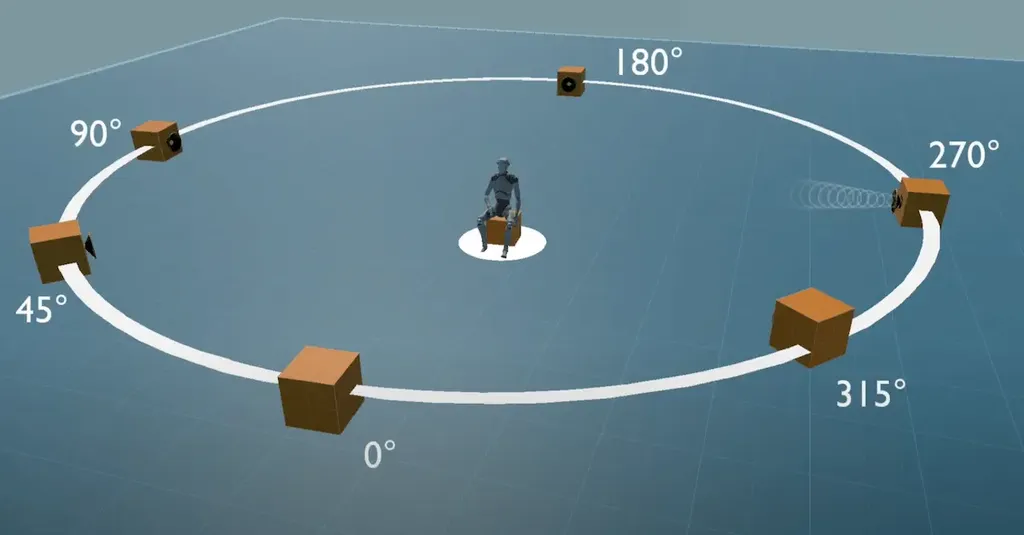
In a groundbreaking development, researchers have introduced a novel concept of proactive hearing assistants that can automatically identify and separate the wearer’s conversation partners without requiring explicit prompts. This innovative system operates using egocentric binaural audio, leveraging the wearer’s self-speech as an anchor. By analyzing turn-taking behavior and dialogue dynamics, the system can infer who the conversational partners are and suppress other background noises. This advancement promises to revolutionize the way hearing assistants function, making them more intuitive and responsive to real-time conversational dynamics.
The system employs a dual-model architecture to ensure real-time, on-device operation. A lightweight streaming model runs every 12.5 milliseconds to provide low-latency extraction of conversation partners, while a slower model runs less frequently to capture longer-range conversational dynamics. This dual approach ensures that the hearing assistant can quickly adapt to the ever-changing dynamics of a conversation, providing clear and uninterrupted audio for the wearer.
The effectiveness of this system has been demonstrated through extensive testing. Researchers collected real-world data from 11 participants, totaling 6.8 hours of 2- and 3-speaker conversation test sets using binaural egocentric hardware. The results showed that the system could generalize well in identifying and isolating conversational partners even in multi-conversation settings. This robust performance highlights the potential of the system to be deployed in various real-world scenarios, enhancing the user experience significantly.
The implications of this research are profound for the music and audio industry. Proactive hearing assistants that can isolate specific conversations could be particularly beneficial in live music production and recording environments. For instance, sound engineers could use such technology to isolate individual instruments or vocalists during a live performance, allowing for more precise sound mixing and enhancement. This could lead to a more immersive and high-quality audio experience for the audience.
Moreover, the dual-model architecture could inspire new approaches in audio processing technologies. The ability to run multiple models simultaneously, each catering to different aspects of audio dynamics, could lead to more sophisticated and adaptive audio systems. This could be particularly useful in applications such as real-time audio transcription, virtual assistants, and even in the development of advanced hearing aids that can adapt to various acoustic environments.
In conclusion, the introduction of proactive hearing assistants represents a significant leap forward in the field of audio technology. By automatically identifying and isolating conversation partners, these assistants can provide a more seamless and intuitive user experience. The dual-model architecture ensures real-time adaptability, making the system highly effective in various real-world scenarios. This research not only enhances the capabilities of hearing assistants but also opens up new possibilities for innovation in the music and audio industry. For more detailed information, visit the project’s website at https://proactivehearing.cs.washington.edu/.