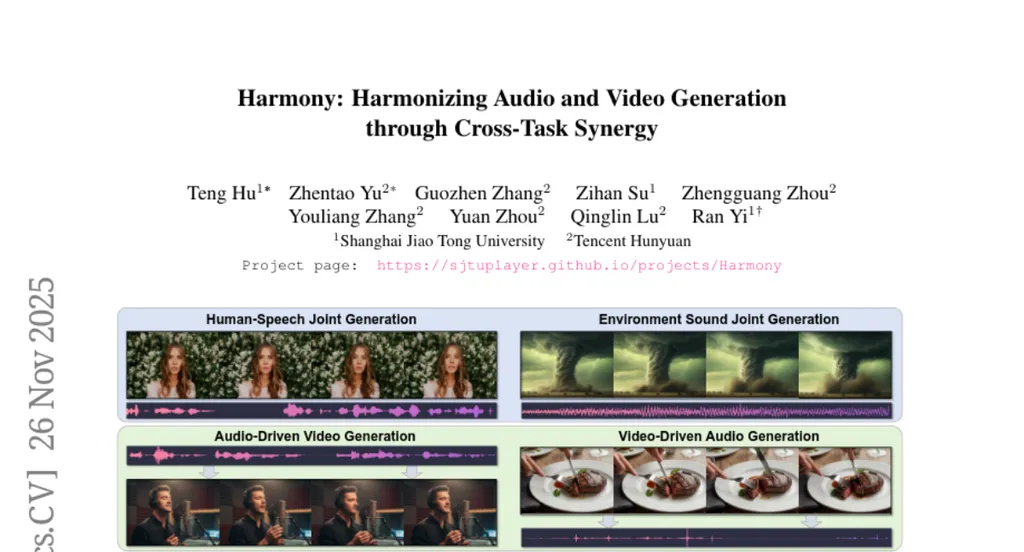
In the world of generative AI, creating synchronized audio-visual content has been a persistent challenge, particularly for open-source models. A team of researchers has identified three core issues that hinder robust audio-video alignment: Correspondence Drift, inefficient global attention mechanisms, and the intra-modal bias of conventional Classifier-Free Guidance (CFG). These problems stem from the joint diffusion process used in these models.
To tackle these obstacles, the researchers have introduced Harmony, a novel framework designed to enforce audio-visual synchronization. The first component of Harmony is a Cross-Task Synergy training paradigm. This approach leverages strong supervisory signals from audio-driven video and video-driven audio generation tasks to mitigate the issue of Correspondence Drift.
The second part of the framework is the Global-Local Decoupled Interaction Module. This module is designed to improve the efficiency and precision of temporal-style alignment. By decoupling global and local interactions, it can capture fine-grained temporal cues that were previously overlooked.
The final piece of the puzzle is the Synchronization-Enhanced CFG (SyncCFG). Unlike conventional CFG, SyncCFG explicitly isolates and amplifies the alignment signal during inference. This ensures that the model enhances cross-modal synchronization, rather than just conditionality.
The researchers conducted extensive experiments to validate their framework. The results were impressive, with Harmony significantly outperforming existing methods in both generation fidelity and fine-grained audio-visual synchronization. This breakthrough could pave the way for more immersive and realistic audio-visual experiences in the future.