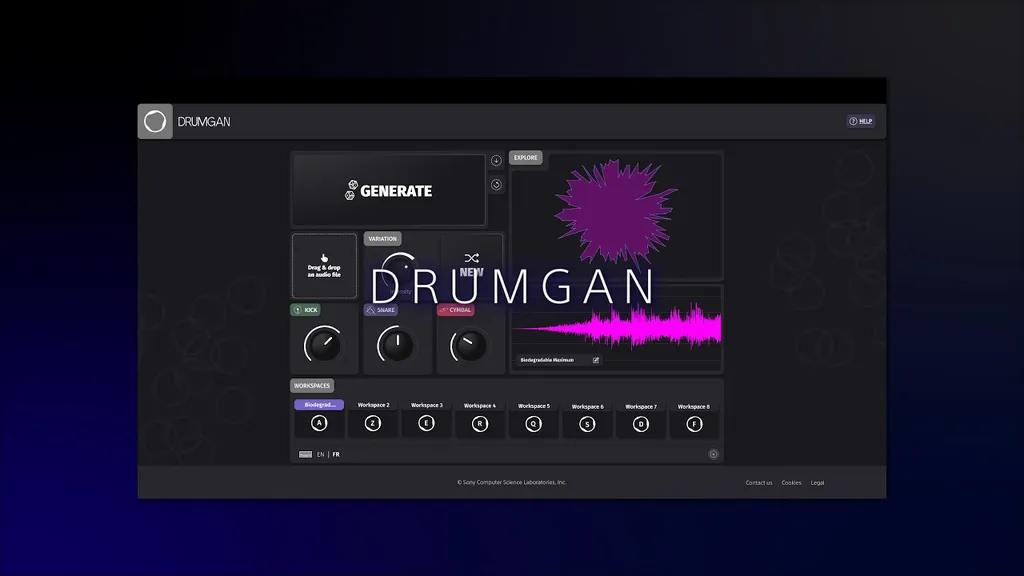
In the ever-evolving landscape of music production, the quest for innovative and efficient methods of sound design is perpetual. A recent breakthrough in this arena comes from researchers Javier Nistal, Cyran Aouameur, Ithan Velarde, and Stefan Lattner, who have developed DrumGAN VST, a plugin that leverages the power of Generative Adversarial Networks (GANs) to synthesize drum sounds. This technology promises to revolutionize the way producers and sound engineers approach drum sound design, offering a more streamlined and creatively flexible process.
Traditionally, drum sound design has been a labor-intensive task, often involving the tedious browsing and processing of pre-recorded samples from extensive sound libraries. Alternatively, specialized synthesis hardware has been used, but these systems are typically controlled through low-level, musically meaningless parameters, which can be cumbersome and require a high level of technical expertise. The advent of Deep Learning, however, has introduced methods that allow for the control of the synthesis process via learned high-level features, enabling the generation of a wide variety of sounds with greater ease and precision.
DrumGAN VST operates at a sample rate of 44.1 kHz, providing high-quality audio output that is on par with traditional methods. One of the standout features of this plugin is its ability to offer independent and continuous instrument class controls. This means that users can fine-tune the characteristics of different drum sounds with a level of granularity and flexibility that was previously unattainable. Additionally, DrumGAN VST includes an encoding neural network that maps sounds into the GAN’s latent space, a concept that might sound complex but essentially allows for the resynthesis and manipulation of pre-existing drum sounds. This feature opens up new avenues for creativity, enabling producers to take existing sounds and transform them into something entirely new and unique.
The practical applications of DrumGAN VST are vast. For music producers, this plugin can significantly speed up the sound design process, allowing for quicker iterations and more efficient workflows. For sound engineers, it offers a new tool for creating custom drum sounds that can enhance the overall quality of a production. Moreover, the ability to manipulate pre-existing sounds means that DrumGAN VST can be used to breathe new life into old samples, providing a fresh perspective on familiar sounds.
The researchers have provided numerous sound examples and a demo of the proposed VST plugin, showcasing its capabilities and demonstrating its potential impact on the music production industry. As with any new technology, there will be a learning curve, but the benefits of DrumGAN VST are clear. It represents a significant step forward in the integration of Deep Learning and artificial intelligence into the creative process, offering a powerful new tool for musicians and producers alike.
In conclusion, DrumGAN VST is a groundbreaking development in the field of music production. By harnessing the power of Generative Adversarial Networks, it offers a more efficient, flexible, and creative approach to drum sound design. As the technology continues to evolve, it will be exciting to see how it shapes the future of music production and sound engineering.