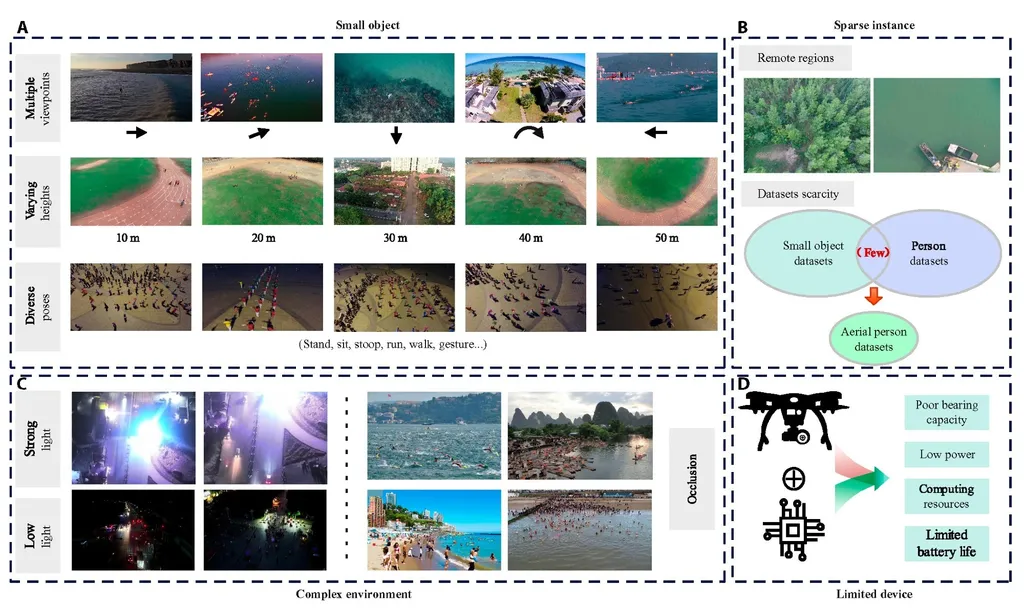
In the realm of search and rescue operations, drones have emerged as invaluable tools, capable of reaching and surveying areas that are otherwise inaccessible or dangerous for human rescuers. Traditionally, these unmanned aerial vehicles (UAVs) have relied on vision-based systems to detect signs of human presence. However, these methods can falter in low-visibility conditions or when obstacles obscure the view. This is where audio perception comes into play, offering a promising alternative that can complement or even surpass visual systems in certain scenarios.
The challenge with drone-based audio perception lies in the extreme ego-noise generated by the drones themselves. This noise can drown out the very sounds that indicate human presence, making it difficult for the system to accurately detect and interpret these crucial audio cues. To address this issue, a team of researchers has developed DroneAudioset, a comprehensive dataset designed to advance the field of drone audition.
DroneAudioset is a significant leap forward in the development of drone-based audio perception systems. It features 23.5 hours of annotated recordings, encompassing a wide range of signal-to-noise ratios (SNRs) from -57.2 dB to -2.5 dB. The dataset’s diversity is further enhanced by the inclusion of various drone types, throttles, microphone configurations, and environments. This breadth of data enables researchers to systematically evaluate and develop noise suppression and classification methods for human-presence detection under challenging conditions.
The creation of DroneAudioset is a collaborative effort led by Chitralekha Gupta, Soundarya Ramesh, Praveen Sasikumar, Kian Peen Yeo, and Suranga Nanayakkara. Their work not only provides a valuable resource for the research community but also highlights practical design considerations for drone audition systems. For instance, the dataset can inform decisions about microphone placement and the development of drone noise-aware audio processing techniques.
The implications of this research extend beyond search and rescue operations. The advancements in drone audition technology could have a wide range of applications, from wildlife monitoring to urban noise pollution mapping. By making DroneAudioset publicly available under the MIT license, the researchers are inviting the global community to contribute to and benefit from this exciting field of study. This open-access approach is likely to accelerate innovation and lead to the development of more robust and versatile drone audition systems.