In the realm of accessible technology, a groundbreaking study has emerged that could revolutionize remote dance instruction for blind and low vision (BLV) individuals. The research, conducted by Ujjaini Das, Shreya Kappala, Meng Chen, Mina Huh, and Amy Pavel, focuses on the challenges of making dance videos accessible through audio descriptions (AD). The study highlights the complexities involved in describing dance movements, which require conveying both the mechanics and the expressive aspects of the dance.
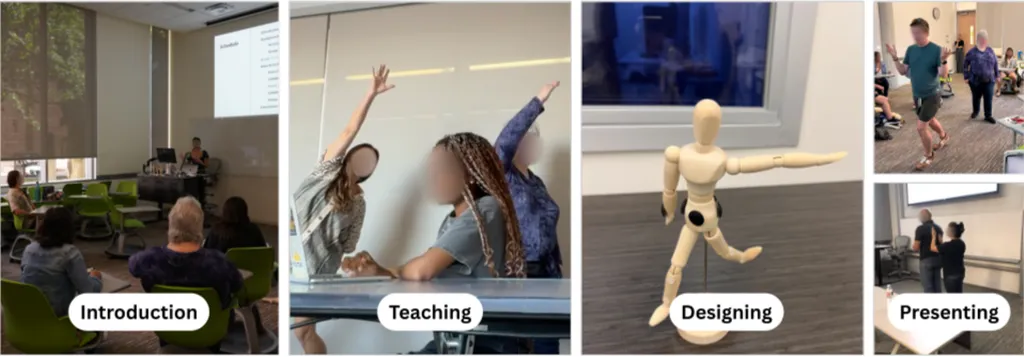
The researchers conducted three co-design workshops involving 28 participants, including BLV dancers, instructors, and experts in sound, haptics, and audio description. These workshops aimed to explore how multimodal instruction could be scaled to support the unique, complex movements and precise timing constraints of dance. The participants designed eight systems that revealed common themes: staged learning to break down dance routines, creating vocabularies for movements, and selectively using different modalities. Narration was identified as essential for conveying the structure of movements, sound for expressing the fluidity and timing, and haptics for providing spatial cues.
The findings of this research offer valuable insights into making dance instruction accessible. The study suggests that a combination of staged learning, where routines are broken down into simpler components, and the use of specialized vocabularies can help BLV learners grasp complex movements more effectively. Additionally, the selective use of narration, sound, and haptics can provide a comprehensive learning experience that addresses both the technical and expressive dimensions of dance.
The implications of this research extend beyond dance instruction. The principles and methodologies developed could be applied to other forms of physical education and instruction that rely on visual demonstrations. By leveraging multimodal systems, educators and technologists can create more inclusive learning environments that cater to the diverse needs of all learners.
The study concludes with design recommendations aimed at making dance learning accessible. These recommendations emphasize the importance of integrating multiple sensory modalities to provide a rich and immersive learning experience. As technology continues to evolve, the insights from this research could pave the way for more innovative and inclusive educational tools, ultimately democratizing access to dance and other forms of physical instruction for BLV individuals.