
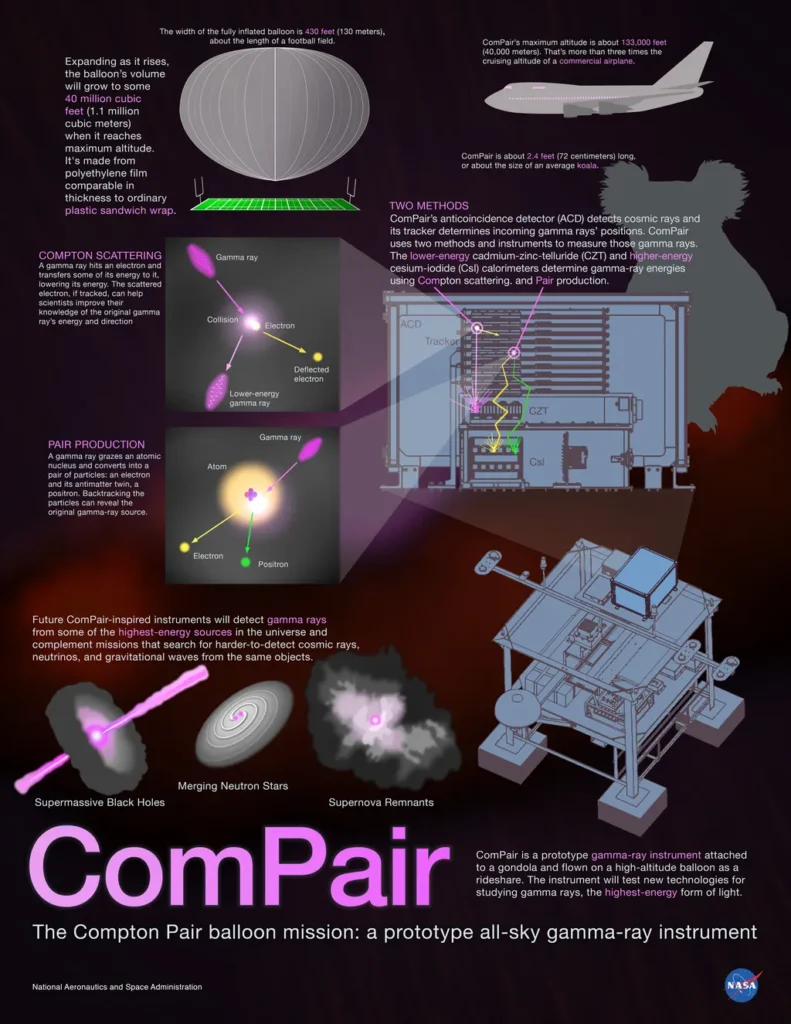
In the realm of astrophysics and gamma-ray observation, the Calibration of the ComPair Balloon Instrument marks a significant stride forward. ComPair, a prototype of the All-sky Medium Energy Gamma-ray Observatory (AMEGO) mission concept, is a sophisticated instrument designed to capture and analyze gamma-ray events with unprecedented precision. This innovative device integrates four critical subsystems: a double-sided silicon strip detector (DSSD) Tracker, a virtual Frisch-grid cadmium zinc telluride (CZT) Low Energy Calorimeter, a cesium iodide (CsI) High Energy Calorimeter, and a plastic scintillator Anti-Coincidence Detector (ACD). These components work in unison to track and measure the locations and energies of gamma-ray scatters and pair production events, thereby reconstructing the events for detailed analysis.
The primary objective of the recent calibration campaign was to benchmark ComPair’s performance in key areas such as angular resolution, energy resolution, and effective area. These metrics are crucial for assessing the instrument’s scientific capabilities before its anticipated balloon launch in 2023. The calibration process involved a series of rigorous tests and simulations to ensure that ComPair meets the expected performance standards. The results of these calibrations were then compared to the performance predictions derived from extensive simulations, providing a comprehensive evaluation of the instrument’s readiness and potential.
The research team, led by Nicholas Kirschner and including notable contributors such as Zachary Metzler, Lucas D. Smith, Carolyn Kierans, Regina Caputo, and others, meticulously detailed the calibration campaign and the subsequent analysis. Their findings offer a robust overview of ComPair’s capabilities, highlighting its potential to significantly advance our understanding of gamma-ray astronomy. The integration of the DSSD Tracker, CZT Low Energy Calorimeter, CsI High Energy Calorimeter, and ACD allows for a holistic approach to gamma-ray detection, enhancing both the sensitivity and accuracy of the observations.
The implications of this research extend beyond the immediate scope of the ComPair instrument. By refining the calibration techniques and performance benchmarks, this study sets a precedent for future gamma-ray observation missions. The detailed calibration process and the subsequent comparison with simulation data provide a blueprint for ensuring the reliability and effectiveness of similar instruments. This meticulous approach not only enhances the scientific rigor of the ComPair mission but also paves the way for more advanced and precise gamma-ray observatories in the future.
In summary, the calibration of the ComPair Balloon Instrument represents a critical milestone in the field of astrophysics. The collaborative efforts of the research team have yielded valuable insights into the instrument’s performance, ensuring its readiness for the upcoming balloon launch. As we look forward to the data that ComPair will gather, the scientific community anticipates significant advancements in our understanding of gamma-ray events, thanks to the groundbreaking work detailed in this research.