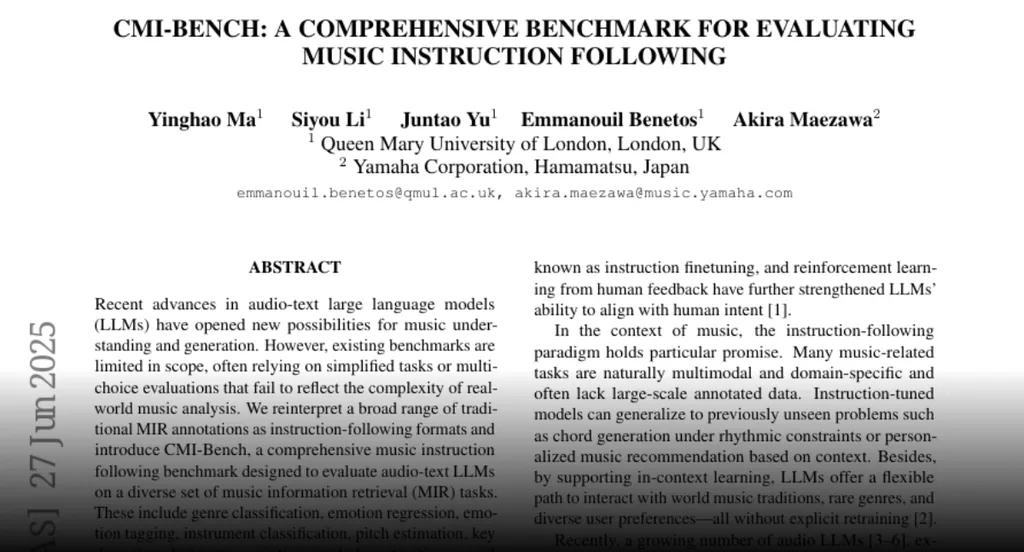
In a significant stride forward for music technology, researchers have introduced CMI-Bench, a comprehensive benchmark designed to evaluate the capabilities of audio-text large language models (LLMs) in understanding and generating music. This innovative benchmark reinterprets a wide array of traditional music information retrieval (MIR) annotations into instruction-following formats, offering a more nuanced and realistic assessment of these models’ performance.
CMI-Bench encompasses a diverse set of MIR tasks, including genre classification, emotion regression, emotion tagging, instrument classification, pitch estimation, key detection, lyrics transcription, melody extraction, vocal technique recognition, instrument performance technique detection, music tagging, music captioning, and (down)beat tracking. These tasks reflect the core challenges in MIR research and provide a holistic evaluation of audio-text LLMs. Unlike previous benchmarks, CMI-Bench adopts standardized evaluation metrics consistent with state-of-the-art MIR models, ensuring direct comparability with supervised approaches.
The research team, led by Yinghao Ma, Siyou Li, Juntao Yu, Emmanouil Benetos, and Akira Maezawa, provides an evaluation toolkit that supports all open-source audio-textual LLMs, including LTU, Qwen-audio, SALMONN, and MusiLingo. This toolkit facilitates the integration of CMI-Bench into existing workflows, making it a practical resource for developers and researchers alike.
Experiment results reveal significant performance gaps between LLMs and supervised models, highlighting the potential and limitations of current models in addressing MIR tasks. Notably, the benchmarks also exposed cultural, chronological, and gender biases in the models, underscoring the need for more inclusive and representative datasets in music technology research.
The practical applications of CMI-Bench are vast. For music producers and audio engineers, this benchmark can aid in the development of more sophisticated tools for music analysis and generation. For instance, accurate emotion tagging and genre classification can enhance music recommendation systems, while precise pitch estimation and melody extraction can improve automated transcription and composition tools. Moreover, the benchmark’s ability to evaluate vocal and instrument technique recognition can lead to advanced tools for music education and performance analysis.
In conclusion, CMI-Bench represents a significant advancement in the evaluation of audio-text LLMs for music understanding and generation. By providing a comprehensive and standardized benchmark, it paves the way for more robust and inclusive music technology, driving progress in the field and opening new possibilities for music creation and analysis. Read the original research paper here.