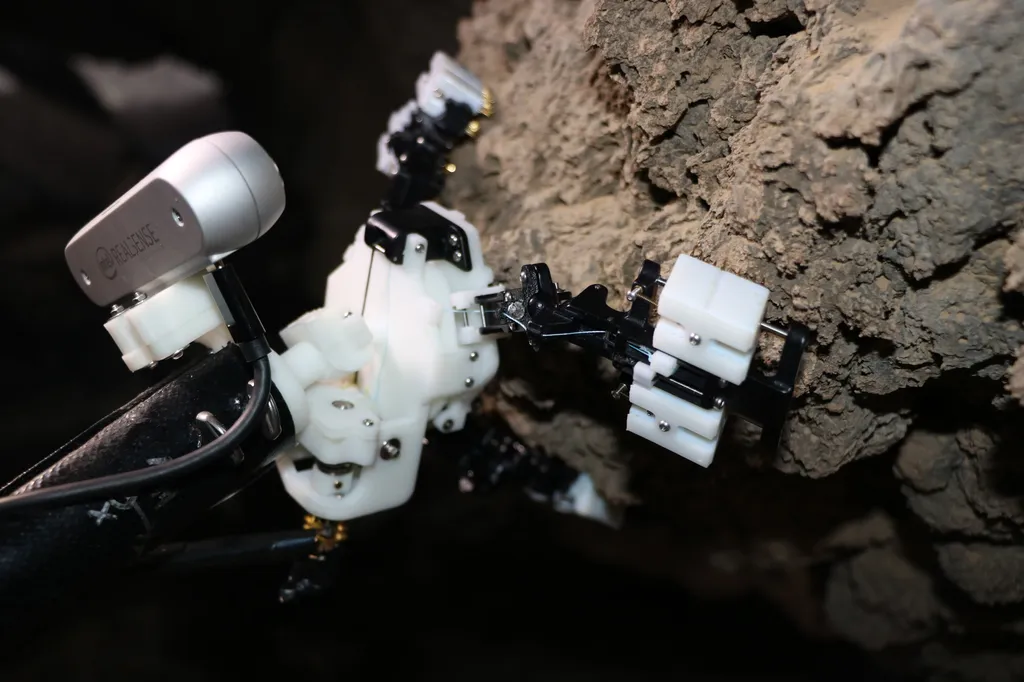
In the rapidly evolving world of robotics, a new player has emerged that is set to redefine the way robots interact with and understand their environment. Meet CAVER, a curious audiovisual exploring robot developed by a team of researchers including Luca Macesanu, Boueny Folefack, Samik Singh, Ruchira Ray, Ben Abbatematteo, and Roberto Martín-Martín. CAVER is not just another robot; it’s a breakthrough in multimodal audiovisual perception, a technology that could unlock new avenues for robotic manipulation.
CAVER’s unique selling point is its ability to learn the correlations between an object’s visual appearance and the sound it generates when the robot interacts with it. This active sensorimotor experience is made possible by three novel contributions. The first is a novel 3D printed end-effector, attachable to parallel grippers, that excites objects’ audio responses. This means that CAVER can physically interact with objects in a way that elicits a sound, providing it with a rich source of data.
The second contribution is an audiovisual representation that combines local and global appearance information with sound features. This representation allows CAVER to create a comprehensive ‘picture’ of an object, incorporating both its visual and auditory characteristics. The third contribution is an exploration algorithm that uses and builds the audiovisual representation in a curiosity-driven manner. This algorithm prioritizes interacting with high uncertainty objects, ensuring that CAVER obtains good coverage of surprising audio with fewer interactions.
The implications of CAVER’s technology are vast. For instance, it could significantly improve material classification, a task that is currently based primarily on visual information. By incorporating auditory data, robots like CAVER could achieve a more nuanced and accurate understanding of the materials they encounter. Furthermore, CAVER’s technology could enable robots to imitate audio-only human demonstrations, such as playing a tune by ear. This could open up new possibilities for robotics in fields like music and art, where the ability to interpret and replicate auditory information is crucial.
In conclusion, CAVER represents a significant step forward in the field of robotics. Its ability to learn and utilize audiovisual representations of objects could pave the way for more intelligent, adaptable, and versatile robots. As the team of researchers continues to refine and develop CAVER’s technology, we can expect to see even more innovative applications and breakthroughs in the future.