
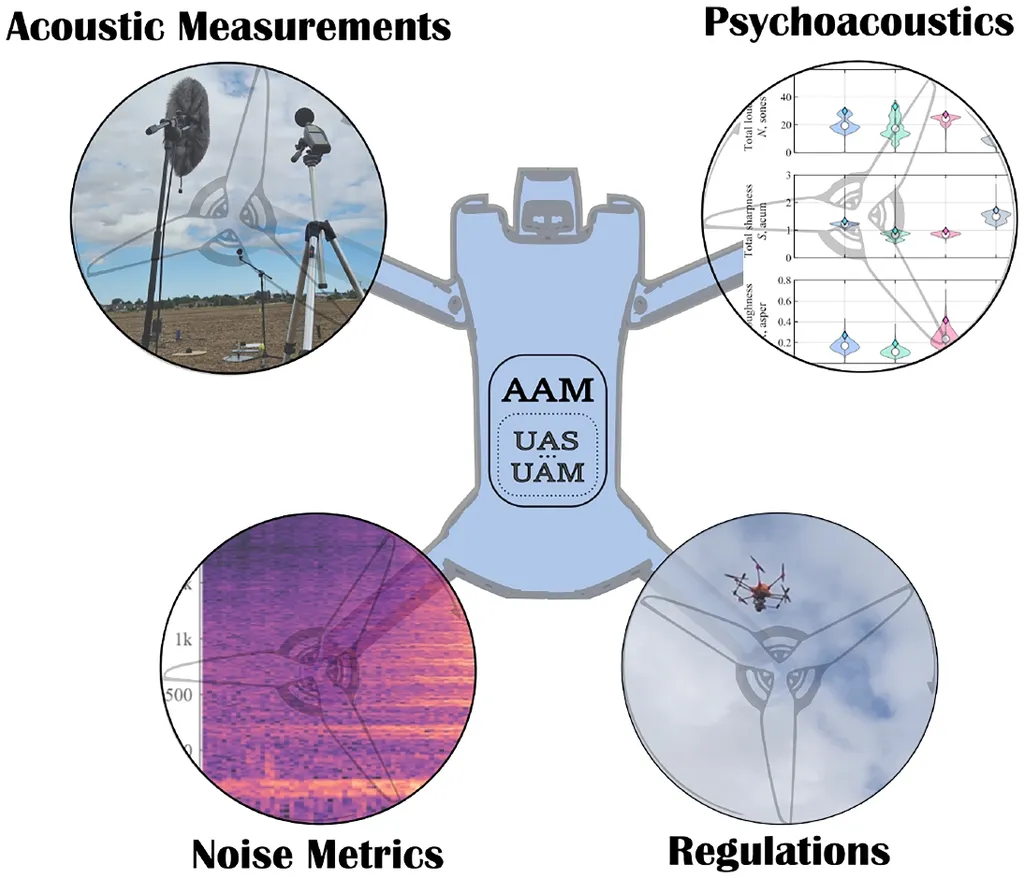
A landmark study published this week in The Journal of the Acoustical Society of America has unveiled a new generation of psychoacoustic prediction models, specifically designed to assess and mitigate the short-term noise annoyance caused by unmanned aircraft systems (UAS) in urban environments. This breakthrough, developed by researchers at the University of Southampton and the German Aerospace Center, represents a paradigm shift in how acoustic scientists and urban planners can address the burgeoning challenge of noise pollution from drones and electric aircraft—an issue set to intensify as urban air mobility (UAM) becomes a reality.
The new models are the first to integrate laboratory-acquired psychoacoustic data with real-world acoustic environments, enabling the prediction of human annoyance responses to UAS noise with unprecedented accuracy. Unlike traditional noise metrics, which rely on objective measurements such as decibel levels, these models incorporate subjective perceptual dimensions—sharpness, roughness, and fluctuation strength—to provide a holistic assessment of noise impact. This approach not only aligns with the latest ISO standards for psychoacoustic metrics but also bridges the gap between objective acoustic characterization and human-centered soundscape design.
At the heart of this innovation is the use of advanced signal processing and machine learning to analyze and predict annoyance from both single and multiple UAS events. The models were developed using data from controlled listening tests, where participants were exposed to auralized UAS sounds embedded in urban ambient noise. “The ability to predict annoyance in real time, based on both the acoustic signature of the UAS and the context of the urban soundscape, is a game-changer,” explains Dr. Antonio Torija Martínez, one of the study’s lead authors. “This allows us to move beyond static noise maps and towards dynamic, adaptive noise management systems that can inform flight path optimization and vehicle design”.
The implications for the audio and acoustic engineering community are profound. As cities prepare for the integration of UAS and electric vertical take-off and landing (eVTOL) aircraft, the need for robust, predictive noise assessment tools has never been more urgent. The new models are already being integrated into the “RefMap” project, an online platform aimed at optimizing flight paths and reducing community noise exposure. For audio professionals, this means access to more accurate, context-aware tools for environmental noise control, while researchers now have a framework to further explore the interplay between psychoacoustics and urban soundscapes.
This breakthrough not only advances the science of noise control but also underscores the importance of interdisciplinary collaboration in shaping the future of urban acoustics. As the boundaries between transportation, architecture, and acoustic engineering blur, innovations like these will be critical in ensuring that the sounds of tomorrow’s cities are as harmonious as they are functional.
**Sources:**
* https://pubs.aip.org/asa/jasa/article/158/3/2062/3363300/Development-of-psychoacoustic-prediction-models
* https://www.sciencedirect.com/science/article/abs/pii/S2352710225014202
* https://pubs.aip.org/asa/jasa/article/158/3/2062/3363300/Development-of-psychoacoustic-prediction-models
* https://pubs.aip.org/asa/jasa/article/158/3/2062/3363300/Development-of-psychoacoustic-prediction-models
* https://www.head-genuit-stiftung.de/en/projects/projects-psychoacoustics/
* https://pubs.aip.org/asa/jasa/article/158/3/2062/3363300/Development-of-psychoacoustic-prediction-models

