In a significant stride towards enhancing communication for individuals with dysarthria, researchers have introduced a novel approach to data augmentation that promises to revolutionize dysarthric speech recognition (DSR) systems. This breakthrough addresses a critical challenge in the field: the scarcity of data that hampers the development of effective sentence-level DSR systems.
The research, led by Shiyao Wang, Shiwan Zhao, Jiaming Zhou, and Yong Qin, focuses on the potential of dysarthric data augmentation (DDA) to generate training data for automatic speech recognition tasks. The team highlights that while generative models are often employed for this purpose, their success depends on the synthesized data’s ability to accurately represent the target domain. However, the vast variability in pronunciation among dysarthric speakers makes it difficult for models trained on existing speakers’ data to produce useful augmented data, particularly in zero-shot or one-shot learning settings.
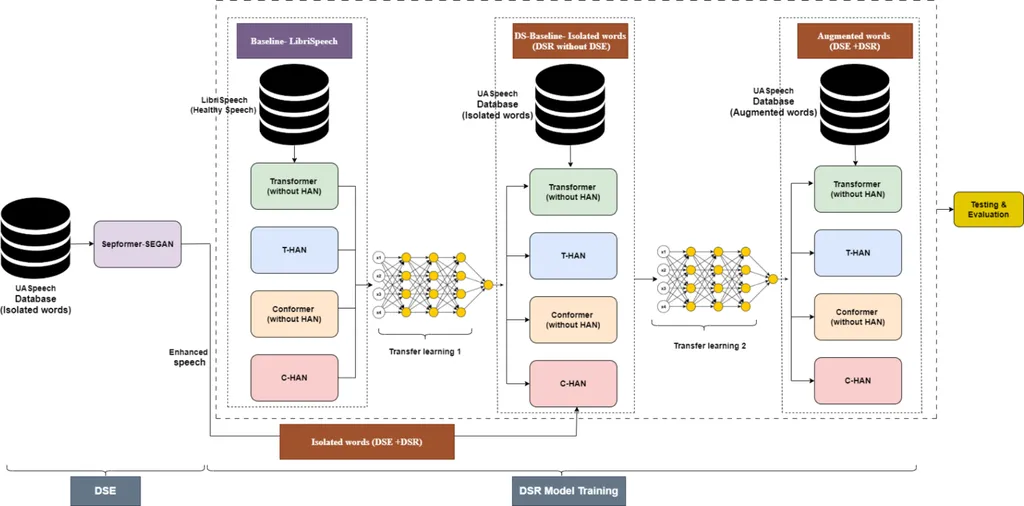
To overcome this limitation, the researchers propose a novel text-coverage strategy designed specifically for text-matching data synthesis. This innovative strategy enables efficient zero/one-shot DDA, leading to substantial improvements in DSR performance when encountering unseen dysarthric speakers. The implications of this research are far-reaching, with practical applications ranging from dysarthria rehabilitation programs to everyday communication scenarios.
The team’s approach involves leveraging the unique characteristics of dysarthric speech to create a more robust and adaptable DSR system. By focusing on sentence-level expressions, the research moves beyond the basic understanding of individual words, aligning with the pressing communication needs of individuals with dysarthria. The novel text-coverage strategy ensures that the synthesized data is representative of the target domain, thereby enhancing the model’s ability to recognize and interpret dysarthric speech accurately.
This breakthrough in DSR technology holds promise for improving the quality of life for those affected by dysarthria. By enabling more effective communication, the research paves the way for better rehabilitation outcomes and greater independence for individuals with this condition. As the field of DSR continues to evolve, the innovative strategies developed by Wang, Zhao, Zhou, and Qin are poised to play a crucial role in advancing the state-of-the-art in this vital area of research. Read the original research paper here.