
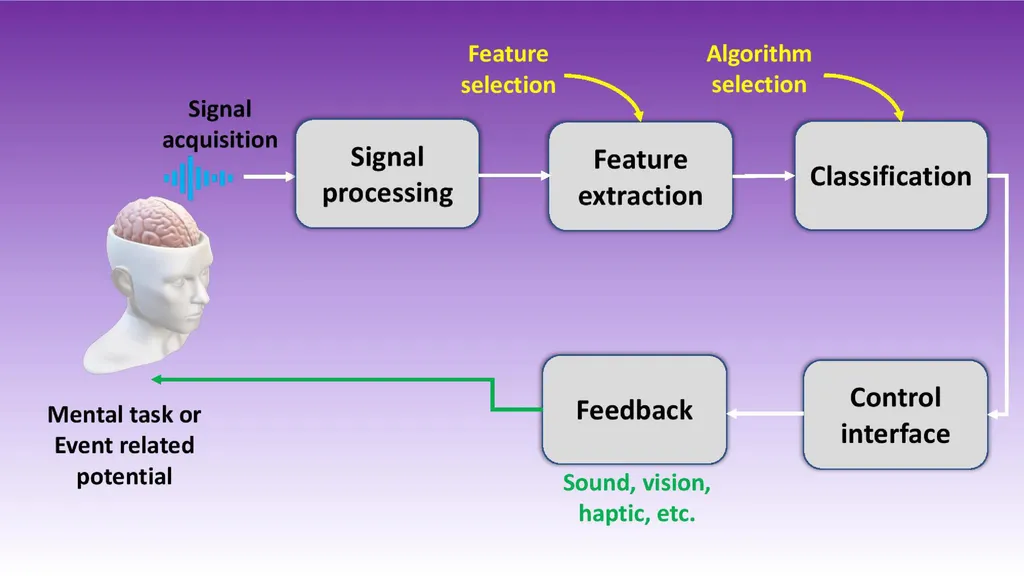
In a significant leap forward for brain-computer interfaces (BCIs), researchers have introduced an innovative end-to-end Brain-to-Text (BIT) framework that promises to revolutionize how neural activity is translated into coherent text. This breakthrough could be a game-changer for individuals with paralysis, offering a more efficient and accurate way to restore communication.
Traditional BCIs often rely on a cascaded approach, where neural activity is first decoded into phonemes—individual speech sounds—and then assembled into sentences using a language model. This method, however, has limitations because it doesn’t allow for the simultaneous optimization of all stages. The new BIT framework overcomes this hurdle by using a single differentiable neural network to translate neural activity directly into text, streamlining the process and enhancing accuracy.
At the heart of the BIT framework is a pretrained neural encoder that has been cross-task and cross-species tested. This encoder’s versatility allows it to handle both attempted and imagined speech, making it a robust tool for various applications. When used in a cascaded setting with an n-gram language model, this pretrained encoder has already set a new state-of-the-art benchmark on the Brain-to-Text ’24 and ’25 datasets.
The integration of audio large language models (LLMs) with contrastive learning for cross-modal alignment further enhances the BIT framework’s performance. This approach significantly reduces the word error rate (WER) from 24.69% to 10.22%, a remarkable improvement over previous end-to-end methods. Interestingly, the researchers found that even small-scale audio LLMs can markedly improve end-to-end decoding, highlighting the potential for scalable solutions in this field.
Beyond its impressive performance metrics, the BIT framework also enables cross-task generalization by aligning embeddings of attempted and imagined speech. This capability paves the way for more versatile and adaptable BCIs that can handle a wider range of neural inputs. By advancing the integration of large, diverse neural datasets, the BIT framework supports seamless, differentiable optimization, making it a powerful tool for future developments in BCIs.
The implications of this research extend beyond medical applications. The ability to decode neural activity accurately and efficiently could open new avenues in human-computer interaction, neuroprosthetics, and even creative fields like music and audio production. As we continue to push the boundaries of what’s possible with neural interfaces, the BIT framework stands as a testament to the potential of end-to-end, differentiable approaches in translating the complexities of the human brain into actionable insights.