
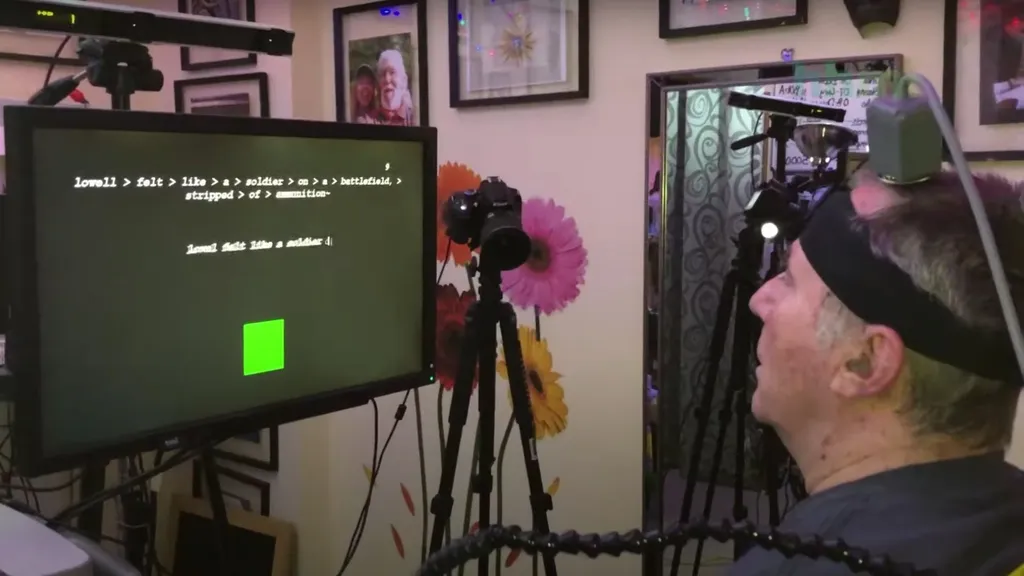
In a significant leap forward for brain-computer interfaces (BCIs), researchers have introduced an innovative end-to-end Brain-to-Text (BIT) framework that translates neural activity into coherent sentences using a single differentiable neural network. This new approach marks a departure from traditional cascaded frameworks, which decode phonemes before assembling sentences with an n-gram language model (LM). By integrating all stages into one cohesive system, the BIT framework allows for joint optimization, enhancing the overall performance and efficiency of neural decoding.
At the heart of this breakthrough is a cross-task, cross-species pretrained neural encoder. This encoder’s representations transfer effectively to both attempted and imagined speech, making it a versatile tool for various applications. When used in a cascaded setting with an n-gram LM, the pretrained encoder sets a new state-of-the-art (SOTA) on the Brain-to-Text ’24 and ’25 benchmarks. This achievement underscores the encoder’s robustness and its potential to revolutionize neural decoding technologies.
The BIT framework’s integration with audio large language models (LLMs) and its training with contrastive learning for cross-modal alignment further enhance its capabilities. By reducing the word error rate (WER) of the prior end-to-end method from 24.69% to 10.22%, BIT demonstrates a substantial improvement in accuracy. Notably, the researchers found that small-scale audio LLMs significantly improve end-to-end decoding, highlighting the importance of scalable and efficient models in advancing BCI technologies.
Beyond its record-setting performance, the BIT framework enables cross-task generalization by aligning attempted and imagined speech embeddings. This capability paves the way for more versatile and adaptable BCIs that can handle a wider range of neural inputs. The researchers’ approach also advances the integration of large, diverse neural datasets, supporting seamless, differentiable optimization. This integration is crucial for developing more sophisticated and accurate neural decoding systems.
The implications of this research are profound for the field of BCIs and beyond. By providing a more efficient and accurate means of translating neural activity into text, the BIT framework could significantly improve communication for individuals with paralysis. Moreover, the framework’s ability to generalize across tasks and species opens up new possibilities for research and development in neural interfaces. As the technology continues to evolve, it holds the promise of transforming how we interact with machines and the world around us.
In summary, the introduction of the BIT framework represents a major advancement in the field of brain-computer interfaces. Its innovative approach to neural decoding, combined with its impressive performance metrics, positions it as a key player in the future of neural technology. As researchers continue to refine and expand its capabilities, the BIT framework could unlock new potentials for communication, rehabilitation, and beyond.