
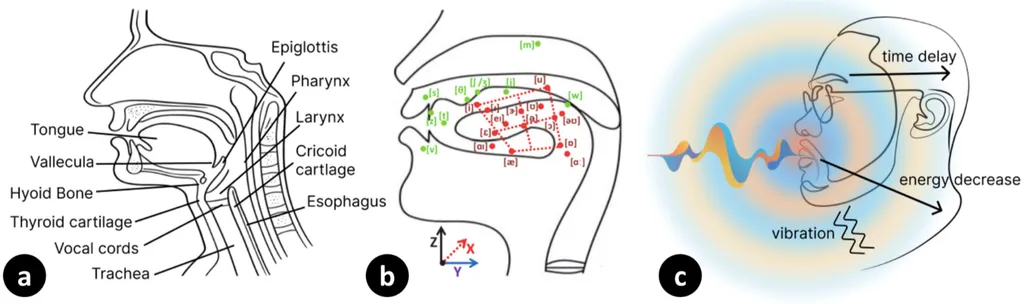
In the rapidly evolving world of wearable tech, smart glasses are emerging as a promising platform for hands-free, voice-driven interaction. However, the convenience of voice control comes with a significant caveat: the vulnerability to spoofing attacks and the interference from ambient noise. To tackle this challenge, a team of researchers from various institutions, led by Weiye Xu, has developed AuthGlass, an innovative voice authentication approach that combines both air- and bone-conducted speech features to bolster accuracy and security.
The team built a prototype smart glasses system equipped with an array of 14 air-conductive microphones and 2 bone-conductive units, all synchronized to capture a comprehensive range of speech-related acoustic and vibration features. This dual-input design allows AuthGlass to leverage the unique characteristics of both sound waves traveling through the air and vibrations conducted through the skull and facial bones. By analyzing these combined features, the system can more accurately verify the user’s identity and detect live speech, making it more resistant to spoofing attempts.
To validate their approach, the researchers conducted a study with 42 participants, putting AuthGlass through various practical scenarios. The results were promising: the combination of sound-field and vibration features significantly improved authentication robustness and attack resistance. Moreover, AuthGlass maintained competitive accuracy even in the presence of background noise and other real-world interferences, highlighting its potential for seamless integration into everyday smart glasses usage.
For music and audio production professionals, AuthGlass’s technology could open up new avenues for secure, hands-free interaction with devices. Imagine controlling your digital audio workstation or adjusting parameters on a portable mixer simply by speaking, with the assurance that your commands are accurately interpreted and authenticated. Furthermore, the dual-input system could enhance noise cancellation and speech enhancement algorithms, leading to cleaner vocal recordings and improved communication in noisy environments.
While AuthGlass is still in its prototype stage, the research demonstrates a significant step forward in voice authentication technology. As smart glasses and other wearable tech continue to gain traction, secure and seamless voice interaction will become increasingly important. AuthGlass’s innovative approach could very well set the standard for future developments in this exciting field.